
If your outbound texts leave the API as "sent" and then nothing happens, no clicks, no replies, no bounces, you have probably already ruled out your copy. You've rewritten the opener, shortened the call to action, tested different send times. Nothing moves. That's usually because the industry on your business license, not the words in the message, is the thing being filtered.
U.S. wireless carriers do not read every text before deciding whether to deliver it. They decide it by campaign, ahead of time, when a business registers to send bulk SMS under the A2P 10DLC system (Application-to-Person, 10-digit long code). If your industry sits on a carrier's disallowed list, the campaign gets rejected or throttled before a single message goes out, no matter how compliant the actual content is. This article lays out which industries that covers, what the carriers' own published policies say, and what a $225 million settlement announced this week means for one of them.
Why this is a policy problem, not a content problem
The wireless industry's trade group, CTIA, splits all text traffic into two buckets in its official Messaging Principles and Best Practices: "Consumer" messaging, sent by an individual person, and "Non-Consumer" messaging, sent by "a business, organization, or entity" or anyone acting on one's behalf. Non-Consumer traffic is what most people still call A2P, application-to-person. It's the bucket every registered marketing or notification campaign falls into, and it's the bucket carriers actively filter to protect subscribers from what CTIA calls "Unwanted Messages."
To register a Non-Consumer campaign, a business has to declare its use case and industry to The Campaign Registry, and carriers vet that declaration against their own disallowed-content policies before approving throughput. Those policies are published, and they are blunt. Sinch, one of the larger messaging aggregators, spells its version out in a public Disallowed Content Policy that groups entire industries under headings like "High-risk financial services," "Get-rich-quick schemes," and "Debt forgiveness." Nothing in those categories is content-dependent. A perfectly polite, fully consented payday loan reminder is disallowed for the same reason as a scammy one: the industry itself is the flag.
The industries carriers won't register at all
 Reading straight off Sinch's published policy, one of the larger U.S. aggregators, these categories are flatly disallowed on any U.S. long code, 10DLC, toll-free number, or short code, with no approval path at any price:
- Payday loans and short-term high-interest loans
- Debt collection, plus debt forgiveness services (debt consolidation, debt reduction, credit repair programs), grouped together in Sinch's policy
- Gambling and sweepstakes
- Cryptocurrency and stock alerts
- Multi-level marketing, filed under "get-rich-quick schemes" alongside deceptive work-from-home offers and risky investment pitches
- Cannabis and CBD, plus all Schedule 1 and 2 controlled substances
- Promotional messaging from third-party lenders (a direct lender can still message its own existing customers about their own account with express consent, but a lender-on-behalf-of arrangement is out)
Other aggregators publish similar lists with different edges. Some will register a heavily vetted crypto or credit-repair campaign that Sinch won't touch at all; none of them will register payday, gambling, or MLM under any conditions. The specific line moves by aggregator. The fact that there is a line, applied to the industry rather than the message, does not.
The industries carriers approve conditionally, not automatically
A second tier gets registered sometimes, with extra vetting, extra fees, and no guarantee it survives contact with the carrier's filters:
- Lead generation and affiliate marketing. Sinch's own policy allows it only "if carrier-approved," which means case-by-case review rather than a blanket yes.
- Tobacco and vape. Carriers will allow it with a functioning age gate that requires an entered birthdate, not a checkbox. That's the SHAFT framework (Sex, Hate, Alcohol, Firearms, Tobacco) that also governs adult content, alcohol, and firearms marketing, monitored by CTIA and the carriers rather than by statute.
- Real estate wholesaling and other cold-outbound lead gen to public-record numbers. These campaigns routinely get approved at registration and then filtered hard afterward, often to under 20% of what's sent, with no error and no signal back to the sender that anything was dropped.
Why MLM just moved from "risky" to "radioactive"
 MLM has sat on the disallowed list for years, bundled with get-rich-quick schemes because so much MLM recruiting messaging leans on exaggerated income claims. On September 17, 2026, the FTC gave carriers a very specific, very large reason to keep it there. The agency and Washington state announced they had reached a settlement with Amway and two of its affiliates, World Wide Group and Leadership Team Development, over what the FTC called deceptive and unfair earnings claims. The complaint alleges the companies told independent business owners they were "likely to earn substantial income, exceeding $40,000 a year" or that the business would "replace their full-time job or allow them to retire early," while most IBOs who joined after 2020 actually spent more on Amway products and training than they ever made back. It also alleges IBOs were pressured to buy inventory they couldn't resell and, in some cases, instructed to falsely report sales that never happened.
The $225 million settlement is, per the FTC's own release, the largest monetary recovery it has ever collected from an MLM. Almost all of it goes back to consumers. None of that is a carrier rule and it doesn't change what's technically possible to register on a 10DLC campaign. What it does is give every aggregator's compliance team a fresh, headline-scale example of exactly the pattern their disallowed-content policy already exists to keep off their networks. If you run SMS for an MLM, expect scrutiny on any registered campaign to get tighter, not looser, in the aftermath.
What "blocked" looks like in practice
Two different things happen depending on where in the process the block lands, and they look nothing alike from the sender's side. A campaign that gets rejected at registration throws an actual error back through the API or dashboard, something a compliance team can at least see and appeal. A campaign that gets approved but then filtered per message is worse: the API returns "sent," the carrier's spam and content filters quietly drop or delay a percentage of the traffic on the way to the handset, and nothing in your dashboard flags it. That mechanism is why payday lenders in particular report delivery collapsing to 30 to 50 percent of what they send, with no error, no bounce, and no appeal path. The campaign was never rejected. The traffic is just being quietly discarded, message by message, after the fact.
The channel carrier gating doesn't reach
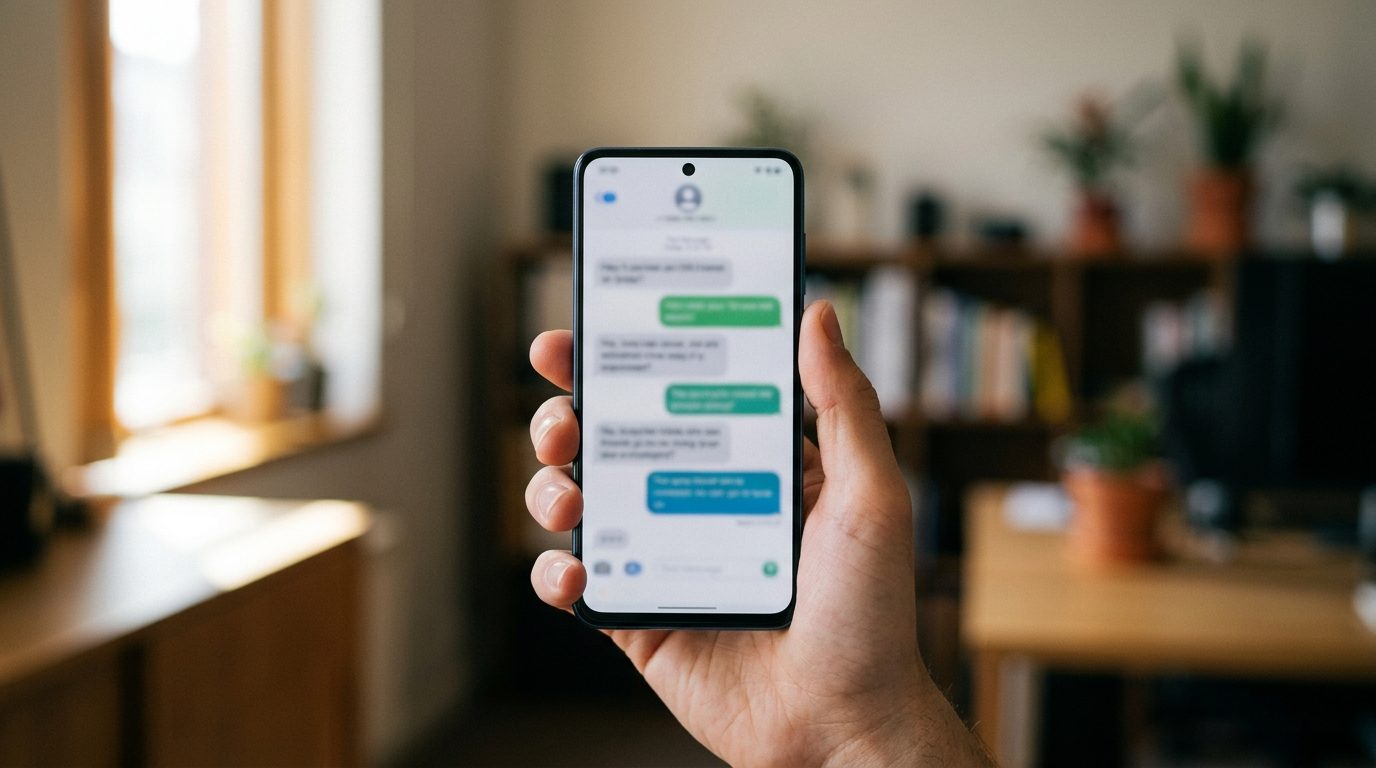 Everything above describes A2P 10DLC: a carrier-run gate that sits between a registered business and its customers, built specifically to vet Non-Consumer traffic before it hits the network. It has nothing to do with the TCPA, which is federal law and governs consent, not carrier registration, and it keeps applying no matter which channel you send from.
Android Texter routes outbound SMS through a real, user-owned Android handset instead of an aggregator's server infrastructure. The message leaves the same way a text from a friend does: from a real 10-digit number, off a real carrier line, as person-to-person SMS. CTIA's own framework draws the line at who the sender is, an individual versus a business acting through an agent, and P2P traffic simply sits outside the Non-Consumer bucket that 10DLC campaign registration and disallowed-content review apply to. There's no TCR brand to register, no campaign to get rejected, no industry classification to flag.
What doesn't change is the law. The TCPA still requires prior express consent for marketing texts to a wireless number, still requires honoring opt-outs, and still carries the same $500 to $1,500 per-violation exposure it always has under 47 U.S.C. § 227(b)(3). Android Texter doesn't reduce that exposure or advise on it. It just doesn't add a second, carrier-run approval layer on top of it. For an MLM, a lender, a dispensary, or a wholesaler already doing the consent work correctly, that's the whole difference between a channel that works and one that doesn't.
Frequently Asked Questions
Is it illegal for a carrier to block my industry from SMS marketing?
No. A2P 10DLC and each carrier's disallowed-content policy are private industry rules, not federal law. Carriers and aggregators are free to refuse or throttle traffic from any category they choose, the same way a payment processor can decline to underwrite a merchant category. There's no regulatory appeal because no regulator wrote the rule.
Does using P2P SMS make my texts TCPA-compliant?
No, and no provider can promise that. TCPA compliance is about consent and content, who you're texting and whether they agreed to it, and that obligation is on the sender regardless of which channel carries the message. P2P routing changes whether a carrier gate reviews your campaign; it does not change your consent obligations.
Can I appeal a 10DLC campaign rejection if my industry is on the disallowed list?
Generally not if the rejection is industry-based rather than a fixable error like a missing use-case description. Aggregators will tell you the category itself, gambling, MLM, cannabis, is the reason, and there's no revision to the message copy that changes that outcome.
Why is vape treated differently from cannabis if both are age-restricted?
Vape and tobacco fall under the SHAFT framework, which allows age-gated marketing with carrier approval, similar to alcohol and firearms. Cannabis is excluded from that exception because it remains a federally controlled substance regardless of state legality, so carriers won't distinguish a licensed dispensary from an unlicensed seller.
My industry isn't on either list here. Does that mean I'm safe?
Not automatically. Aggregators update disallowed-content policies on their own schedule and don't always publish every restricted category. If a campaign in a gray-area vertical is rejected without a specific error code, ask the aggregator directly whether it's an industry classification issue rather than assuming it's a copy problem.
If your industry is on either list above, better copy will not fix it. What fixes it is a channel that was never subject to the list in the first place. Android Texter routes your outbound through a real phone as person-to-person SMS, so carrier campaign review doesn't apply to it. You still own consent and opt-outs; you just stop waiting on an approval you were never going to get.