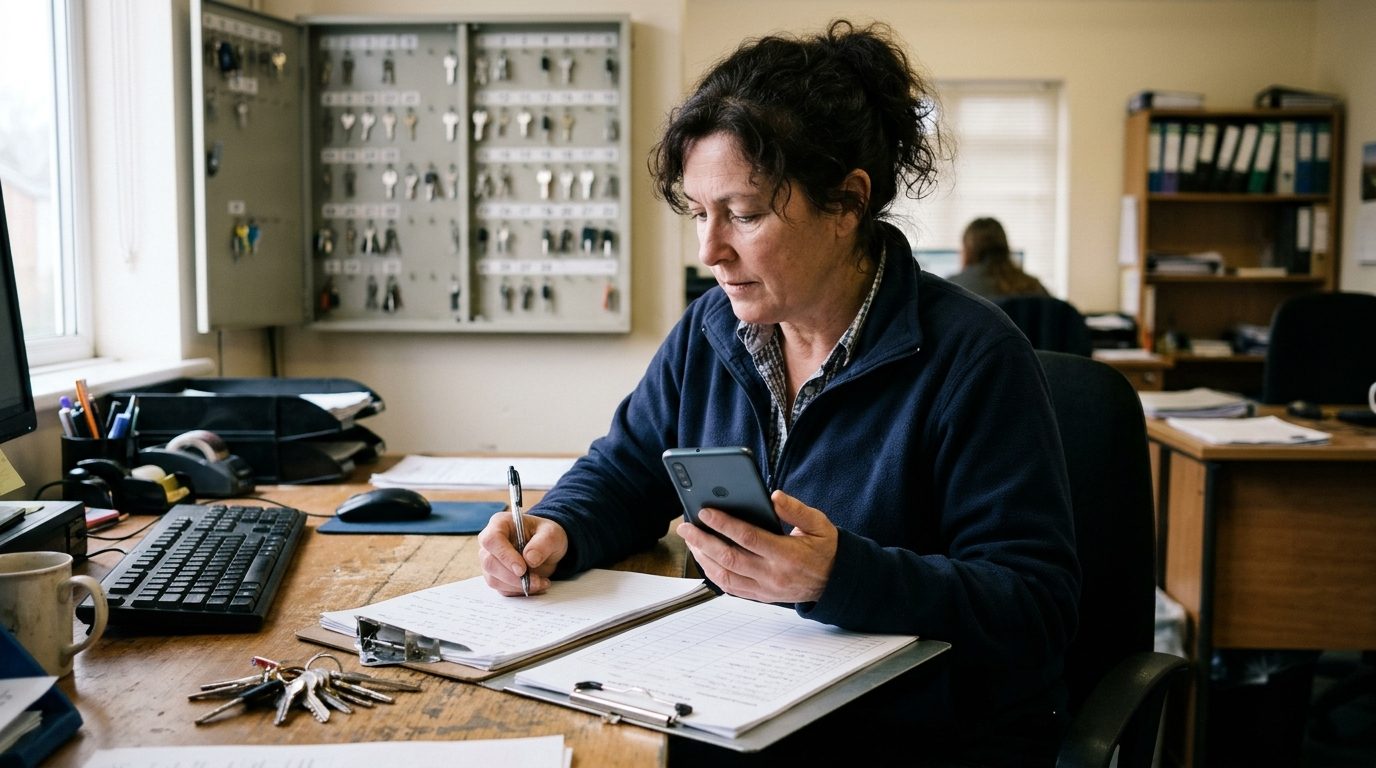
It is 7:40 on a Tuesday and the office line has three new texts: no heat in 12B, a dripping bathroom fan in 4A, and a photo of a cracked window with no unit number. The furnace is a vendor's problem. The four messages between now and close-out are yours, and they decide whether 12B renews in March. Most property managers already text residents. What they rarely have is a fixed sequence, with templates, waits, and a rule for when the tenant goes quiet.
A work order is four texts, not one
From intake, the resident should get four messages, each with its own trigger:
- Acknowledgement, within minutes.
- Entry window, the same business day, with date, approximate time, and purpose.
- On the way, when the tech leaves the previous job.
- Close-out, when the work is marked done, asking whether it is actually fixed.
The AppFolio 2026 Renter Preferences Report, a survey of 3,002 U.S. renters, found that maintenance is the strongest single driver of renter satisfaction and that renters satisfied with maintenance are 81% more likely to renew. Speed is the product. The texts are how the resident sees it.
Text 1: acknowledge inside 15 minutes
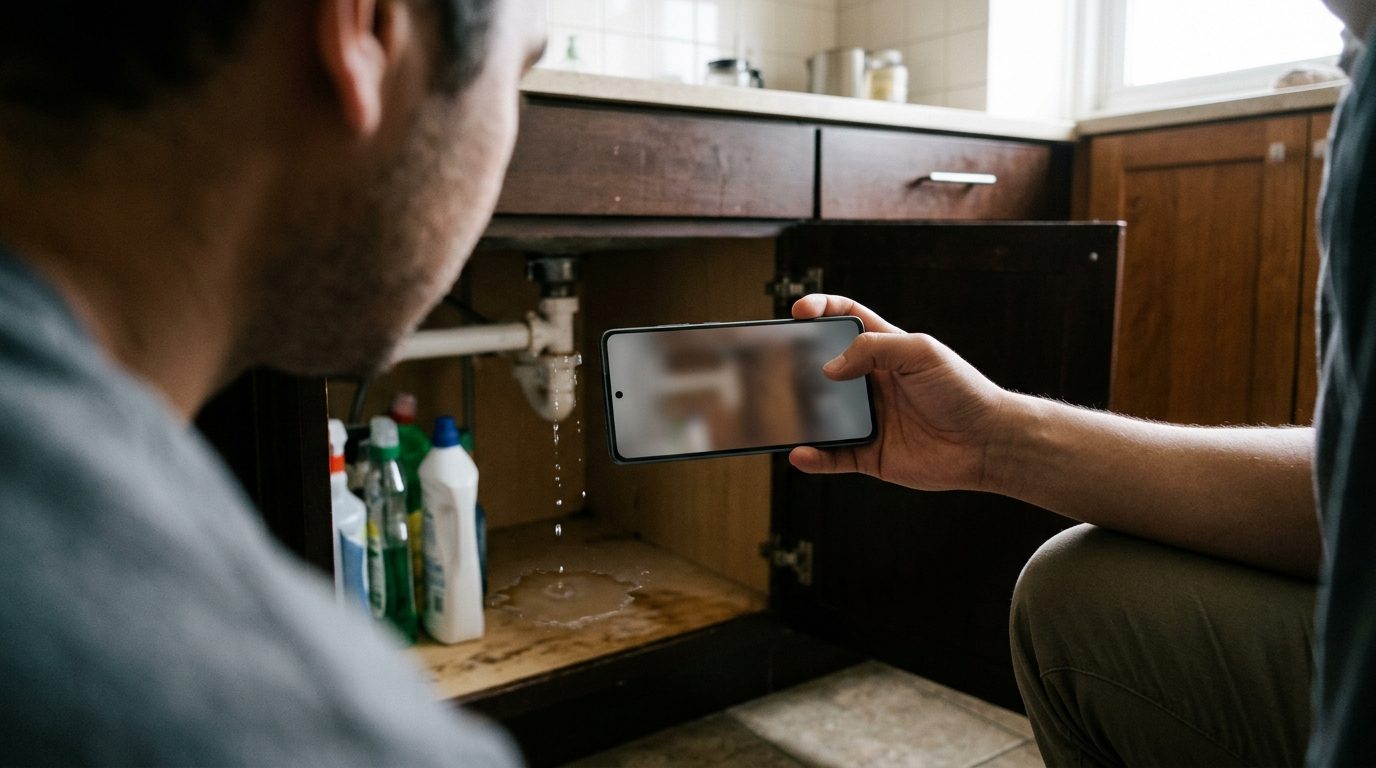 The trigger is the request landing in the inbox. It goes out before anyone calls a vendor, so the resident does not send the same request again by email, portal, and phone.
Hi Dana, this is Marcus at Birchwood Property Management. Got your message about the heat in 12B and opened a work order. Can you reply with a photo of the thermostat and tell me if there is any smell of gas? I will text you a visit time today.
The name and company are there because a resident has no reason to trust an unknown number. The question is specific because "any more details?" gets nothing back. Ask for a photo whenever the issue is visible; Android Texter's inbox is MMS-capable, so it lands in the same thread, and it tells the plumber what to bring.
After hours, an auto-reply rule on the office line sends it:
Thanks for texting Birchwood. The office is closed until 8 am. If this is an emergency (no heat, no water, active leak, gas smell, no power), call the on-call line at (555) 010-2200 now. Anything else, we will reply first thing in the morning.
No reply to the question: do not wait for it. Schedule the vendor on what you know and send the entry window.
Text 2: the entry window is the notice
Most managers send "someone will be by this week," and then the tenant was not home, the dog was, and the tech left. The entry window needs the date, an approximate time, and the purpose. In California, Civil Code section 1954 requires reasonable written notice before a non-emergency entry, presumes 24 hours is reasonable, limits entry to normal business hours unless the tenant agrees, and says the notice "shall include the date, approximate time, and purpose of the entry." Your state and lease will differ, but a text with all three elements is the right shape everywhere.
Dana, the HVAC tech is scheduled for Thursday 11/12 between 9 am and 12 pm to repair the heat in 12B. If you will not be home, reply YES to confirm we can enter with the office key. Any pets we should know about?
Send it the same business day, no later than the morning before the visit, and queue a one-line reminder for 6 pm the evening before with the composer's scheduled-send picker.
No reply to the window: wait until the next morning, then resend once with "Still planning on Thursday 9 to 12 unless we hear otherwise." A reply is a courtesy. Whether you may enter on the written notice alone is a lease and statute question, not an inbox one. The inbox's job is to get the notice out early enough to count and keep a timestamped copy.
Text 3: on the way, from the office number
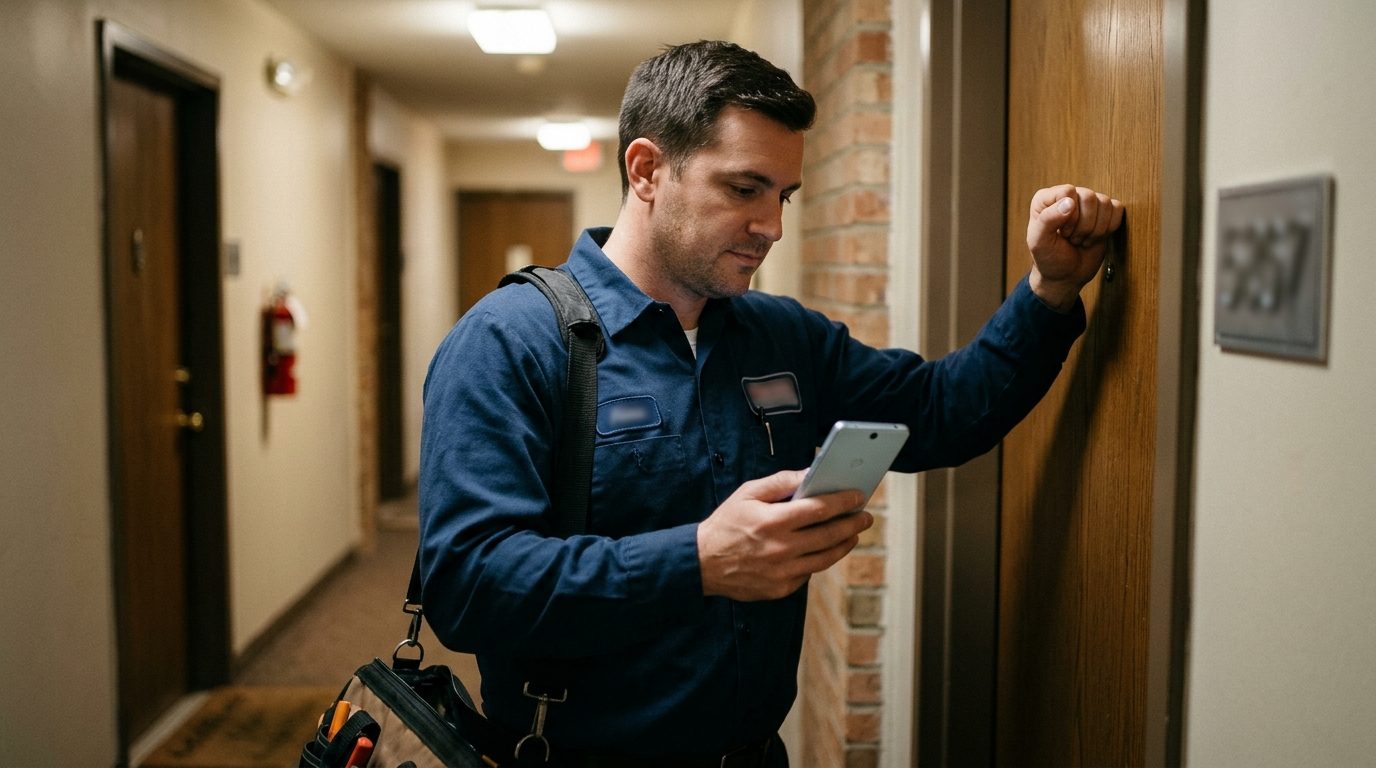 The trigger is the tech leaving the previous job. A ten-minute heads-up gives the resident time to crate the dog or move the car.
Dana, Luis from Comfort Air is on his way to 12B now, about 15 minutes out. He will knock first. Reply here if you need him to wait.
Send this from the office line, not the vendor's phone, because the office number is the thread the resident trusts and the only one you have a record of. A reply ("I'm at work, the key is under the mat") goes to the tech immediately. This is the one point where a slow reply costs a trip charge.
Text 4: close-out, and the question that catches callbacks
When the tech marks the job done, the resident gets one more message, and it asks one question.
Dana, the tech has finished at 12B: replaced the igniter and tested the furnace. Is the heat working for you? Reply YES or tell me what is still wrong.
A job marked complete by a vendor is not the same as a job the resident considers fixed. The furnace fires, but the back bedroom is still cold because the damper was never in scope. Ask, and you learn that in six minutes as a follow-up on the same ticket instead of in six weeks as a complaint.
No reply after 48 hours: close the ticket with a note that the resident was asked and reported nothing.
Emergencies run on the phone, with the text as the record
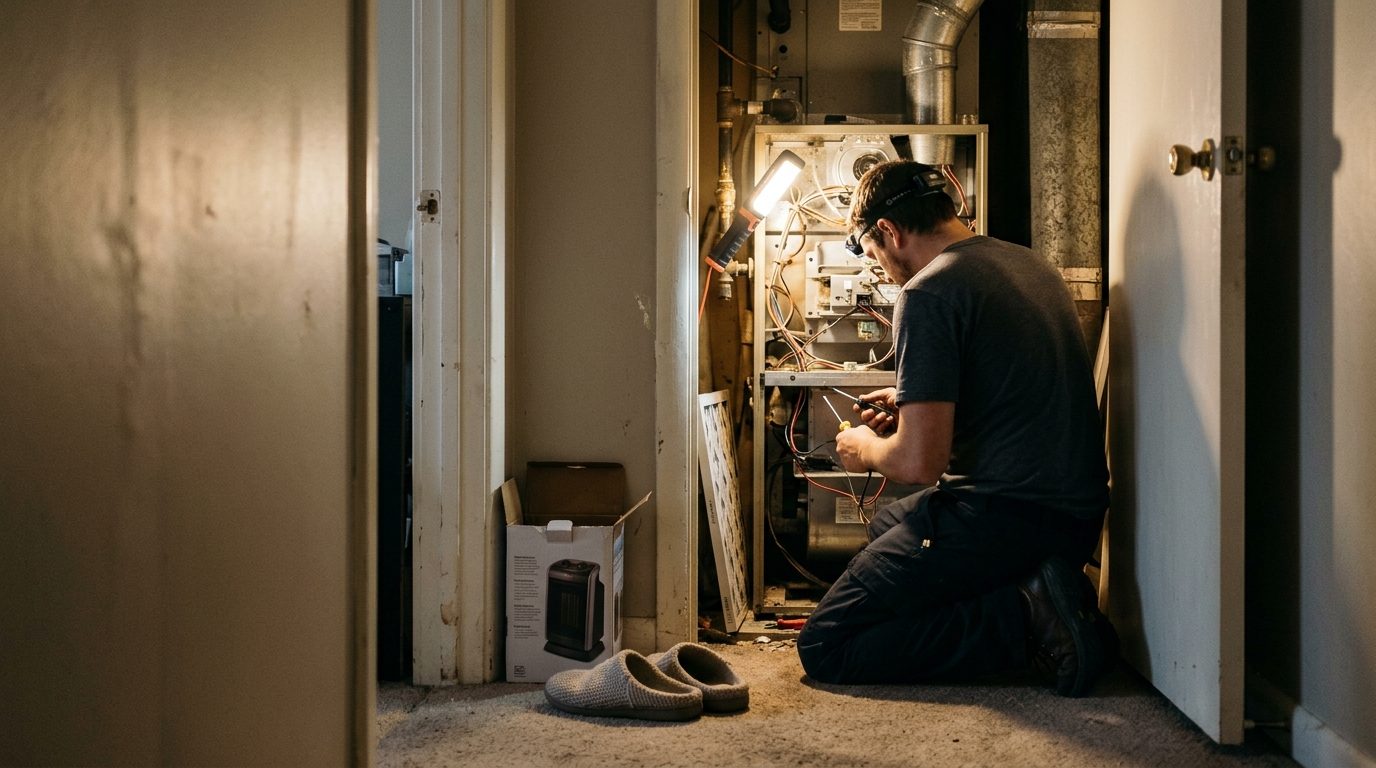 No heat in winter, no water, an active leak, a gas smell, no power: these are not inbox items. The AppFolio survey found that two-thirds of renters want a phone call for an emergency, so the auto-reply points emergencies to a phone number and the on-call person calls back. The text is the written record. After the call, one message goes to the thread:
Dana, following up on our call: Comfort Air is dispatching tonight for the no-heat in 12B, expected by 9 pm. Two space heaters are in the lobby closet if you need them before then. Text or call this line if the tech has not arrived by 9.
That message timestamps your response. Under Texas Property Code section 92.056, a landlord with notice of a condition that materially affects health or safety has a "reasonable time" to repair it. Seven days is presumed reasonable, but the presumption can be rebutted, and the severity and nature of the condition is a factor courts must consider. A no-heat call in January is not a seven-day item, and a thread showing same-night dispatch is the record you want.
A week of the maintenance inbox
 One person owns the maintenance line, and their job is to make sure every open work order has a next text scheduled and nothing is waiting on a reply nobody is watching.
Monday morning is the weekend backlog: everything since Friday evening has had the auto-reply and nothing else. Work oldest first, acknowledgement then entry window, before 10 am.
Every other morning is a five-column triage: new, scheduled, awaiting tenant, awaiting vendor, closed. "Awaiting tenant" is the column that rots. Anything there over a business day gets the single resend.
Quick replies make the volume survivable. Build four, one per text, with name and unit left blank: /ack, /window, /otw, and /done. Android Texter counts how often each is used, which shows whether the sequence is being followed.
Two lines, one inbox. Pair the office handset and the on-call handset to the same account. Both threads land in the same dashboard, so Monday's coordinator sees what Saturday's on-call person did.
What to measure, weekly: time to acknowledgement, time to entry window, time to close-out, and the reopen rate, meaning close-out replies that were anything other than YES. A rising reopen rate is a vendor problem, and the thread tells you which vendor.
Consent, STOP, and what "in writing" means for a text
The rules change three details inside the sequence.
Consent. A repair text is informational, not marketing, but the TCPA still applies to texts to a mobile number. Collect the resident's number and permission to text on the lease or application, and keep the record. Android Texter does not change this; consent is your responsibility, as on any platform.
STOP. If a resident replies STOP, UNSUBSCRIBE, CANCEL, END, or QUIT, honor it and switch them to phone and email. Android Texter does not keep a suppression list and will not block a send to a number that opted out; you can match the keyword with an auto-reply rule, but the list is yours to keep. Our post on what actually counts as a STOP covers the keywords.
"In writing." Whether a text satisfies a written-notice requirement depends on the statute and the lease; California's section 1954 lists personal delivery, leaving the notice at the door, and mail. A text is the notice the resident actually reads, but it may not be the notice the law counts. Send the text and also post the notice by the method your lease names, until your attorney confirms the text alone is enough.
Run the same sequence, with the same targets, for every resident. For the rent side of the same inbox, see the rent reminder playbook for property managers.
Sending the sequence from a number residents already know
A property management office can usually get an A2P 10DLC campaign approved; this is not a blocked vertical. The reason to run maintenance texting through Android Texter is simpler than access. The office already has a number residents recognise, the volume is moderate, and the traffic is two-way: "the key is under the mat" needs to land in front of a human in seconds. An Android handset on the office line, paired to the web dashboard, gives you the threaded inbox, scheduled sends, auto-reply, quick replies, and MMS, with no brand registration, campaign vetting, or per-campaign fee, and multi-device pairing puts the on-call line in the same inbox.
Where it is the wrong answer: a portfolio sending tens of thousands of messages a month from a registered brand through a portal that already runs maintenance tickets. Keep the portal. This playbook is for the office where the work order lives in a spreadsheet and the conversation lives on a phone in the coordinator's desk.
Frequently Asked Questions
Can I send the 24-hour entry notice by text message?
Sometimes, depending on your state and lease. Statutes like California Civil Code 1954 require written notice and list delivery methods such as personal delivery, leaving it at the door, or mail. Send the text with the date, approximate time, and purpose, keep the timestamp, and also use the method your lease names unless your attorney confirms a text alone is enough.
What do I do when a tenant never answers the scheduling text?
Wait one business day, resend the window once with "still planning on Thursday unless we hear otherwise," and move the ticket out of "awaiting tenant." A reply confirms access and pets; it is not what makes the notice valid. Whether you may enter on written notice alone is a lease and statute question.
Should emergency maintenance requests come in by text?
By phone. In the AppFolio 2026 survey, 66% of renters said they want a phone call for an emergency. Point emergencies to the on-call number in the after-hours auto-reply, call back rather than text back, then send one follow-up text so the thread holds a timestamped record of the dispatch.
Run next week's work orders off this
Pick one building, load the four quick replies, set the after-hours auto-reply with your on-call number, and run every request through the four texts for a week. To get both lines in one inbox, set up Android Texter on the Android phone that already answers the office number.