
If you sell for a direct selling or network marketing company and you want to text your leads, your downline, or your customer list, you have probably run into one of two problems. Either your messages never seem to land the way you expect, or nobody at corporate can tell you whether you are even allowed to send them. Those are two different problems with two different causes, and the timing makes it worth untangling them now.
On September 17, 2026, the Federal Trade Commission and the Washington State Attorney General announced a $225 million settlement with Amway Corp. and two affiliates, the largest monetary recovery the FTC has ever obtained from a multilevel marketing company. That case is about recruiting and earnings claims, not about text messages. But it has put every direct selling company's field communications under a brighter light, and text messaging is the one channel almost nobody in that conversation is talking about yet.
What the FTC actually accused Amway of doing
The FTC and Washington alleged that Amway, along with World Wide Group LLC and Leadership Team Development Inc., told recruits they could realistically earn more than $40,000 a year, when most people who joined after 2020 spent more on products and training than they ever got back. The complaint also alleged that Independent Business Owners were pressured to buy inventory they could not resell, and that some were instructed to report sales that never happened.
The proposed order, which still needs a federal judge's signature before it takes effect, requires IBOs to sell at least 70 percent of what they buy from Amway to real customers each month, cuts recruiter compensation for downline purchases that never get resold, mandates sales reporting backed by customer receipts, and bars charging new recruits for training or services during their first year. None of that touches how a distributor is allowed to text someone. It is a case about the recruitment pitch and the inventory model, not the channel used to deliver either one.
The visibility conversation is about social media, not texting
Five days after the settlement, Direct Selling News ran an op-ed arguing that automated compliance monitoring is now essential for the industry. The argument is that manual monitoring, staff doing occasional Google searches, cannot keep pace with what thousands of independent reps post across Instagram, TikTok, and livestreams, and that companies need tooling that flags problem content in hours instead of months.
That is a reasonable response to a settlement about public earnings claims, because Instagram posts and TikTok videos are public and searchable. Text messages are neither. A distributor's texts to a warm lead are a private, one to one channel that no monitoring tool can crawl the way it crawls a hashtag. That makes texting harder to audit, which is exactly why it deserves its own answer instead of getting folded into the social media response everyone is reaching for.
Carriers already treat recruiting language as a red flag
Before any of this year's enforcement news, carriers were filtering MLM style messaging on their own. The major U.S. carriers vet business text traffic before it ever reaches a phone, under a registration system called A2P 10DLC, and multilevel marketing is one of the verticals that system routinely blocks or throttles. Business opportunity language, income claims, and recruitment pitches sent at volume look, structurally, like the same patterns carriers already filter as spam: a stranger's number, a script, a pitch to make money fast. It does not matter that the sender is a real person representing a legitimate company. The pattern is what gets caught.
This is a separate mechanism from the FTC's authority. The FTC enforces truth in advertising and unfair practices law. Carriers enforce their own delivery rules, for their own commercial reasons, with no court and no appeal. A distributor whose texts are silently filtered has no FTC complaint to file, because nothing illegal happened. The carrier just decided not to deliver the message.
Why a distributor can't just register their own line properly
 Here is where the industry's structure creates a problem that individual employees at other companies rarely hit. Most MLM sellers are independent contractors, not employees, and most of them do not have a business tax ID (an EIN). The 10DLC system has a registration path for exactly that situation, called Sole Proprietor registration, which lets someone register using a Social Security number instead of an EIN.
The catch is what Sole Proprietor registration actually gets you: one campaign, one phone number, and a single generic use case, since Twilio's own documentation notes it is the only item available in the use case dropdown for that registration type. There is no marketing specific use case available to a sole proprietor. So a distributor who does the paperwork correctly still ends up with a single low volume line that was never designed for outreach at the scale a real book of leads and customers requires.
The alternative some companies try is registering one corporate brand and routing thousands of individual reps' messages through it. That trades one problem for another: a single brand suddenly fanning out into thousands of people sending similar sounding recruitment and product messages is exactly the traffic shape carrier filters are tuned to catch, regardless of who is technically compliant on paper.
What a distributor is actually doing when they text a lead
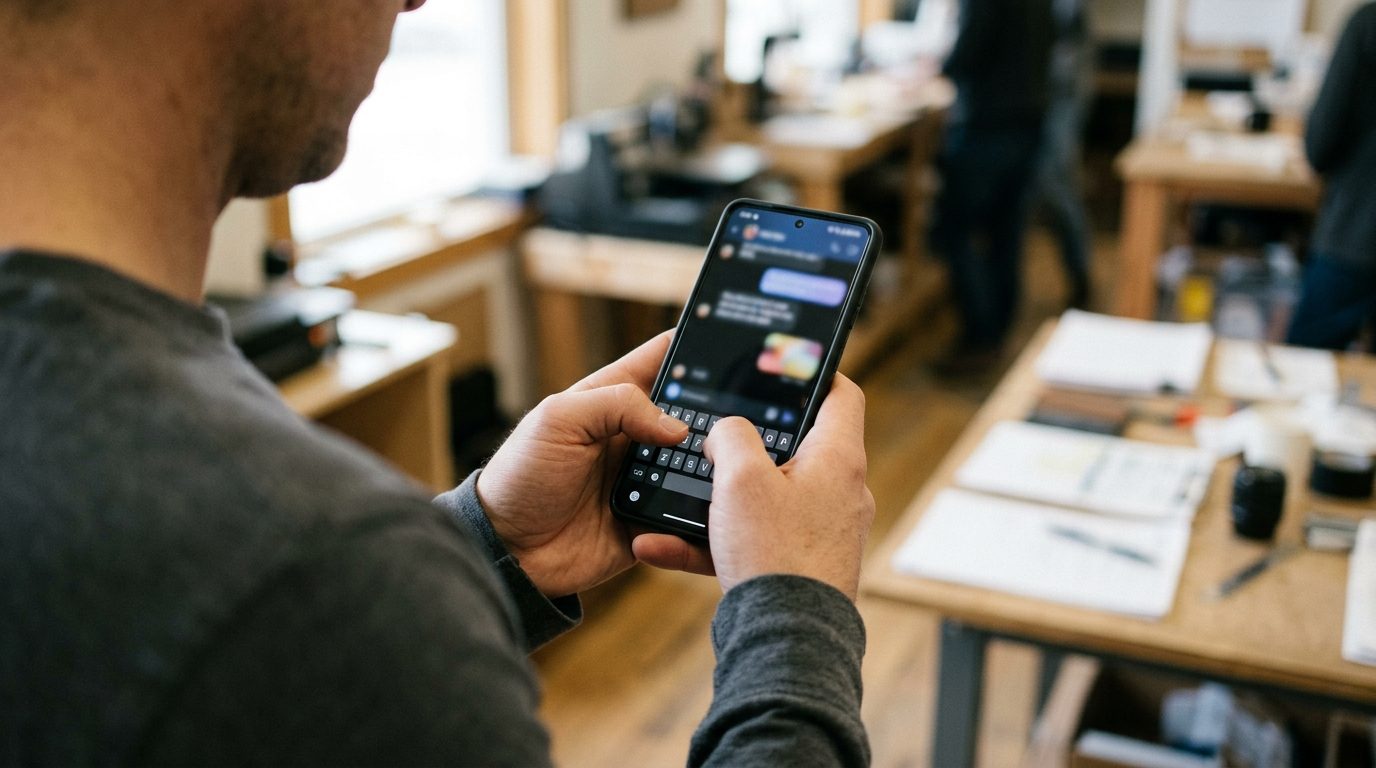 Strip away the registration mechanics and look at what is actually happening when a distributor texts someone. It is a real person, texting from their own number, to someone they met, called, or were introduced to. That is not a business broadcasting to a purchased list. It is person to person texting, which is the thing A2P 10DLC was never built to regulate in the first place, because the entire registration system exists to vet business traffic that impersonates or resembles personal texting at scale.
This is the specific case Android Texter is built around. It turns a distributor's own Android phone into the sending and receiving endpoint, so messages go out as ordinary SMS from a real handset on a real carrier line, the same way a text to a friend does, rather than through a business messaging pipeline that has to be classified and approved first. The web dashboard sits on top of that, giving a distributor working a real pipeline of leads and customers one inbox to manage conversations, save quick replies, and schedule follow ups, instead of trying to run a sales process out of a stock messaging app.
The TCPA still governs what you send, no matter the channel
None of this changes what the law requires. The Telephone Consumer Protection Act, 47 U.S.C. § 227, requires prior express consent before sending a marketing text to a wireless number, and violations carry statutory damages of $500 per message, rising to $1,500 if the conduct was willful. That applies whether the message goes through a carrier registered business line or a personal phone. Getting past a carrier's spam filter has nothing to do with getting past the TCPA, and a distributor who texts someone without consent is exposed under the TCPA regardless of what tool sent the message.
We are not going to tell you a specific message is compliant, because that is a legal judgment, not a technical one, and it depends on facts we cannot see: what the person agreed to, when, and in what words. What we can tell you is the shape of the risk. Consent has to come from the person being texted, it has to cover the kind of message you are sending, and revoking it has to be honored the moment it happens, by text, call, or any other reasonable means.
What compliant distributor texting looks like day to day
 In practice, the distributors who avoid trouble tend to do a small number of things consistently. They get consent at the point of first contact, whether that is a form, an in person conversation, or a reply confirming interest, rather than assuming a purchased or scraped list is fair game. They keep a record of when and how that consent was given, because in a TCPA dispute the burden of proving consent falls on the sender. They write their own messages instead of copy pasting an identical corporate script to hundreds of contacts, both because personalized outreach converts better and because identical scripted blasts from thousands of individual senders are what make the whole channel look automated in the first place. And they treat STOP, UNSUBSCRIBE, CANCEL, and similar replies as immediate and permanent, not something to follow up on just this once.
None of this is unique to direct selling. It is the same discipline any small business texting real customers should already have. What is unique to this industry is the scale: one company's compliance posture depends on thousands of individually contracted people getting all of this right, which is exactly the visibility problem the Direct Selling News op-ed was pointing at, just for a channel it did not mention.
Frequently Asked Questions
Does the FTC's Amway settlement change how MLM distributors can text customers?
No. The settlement addresses earnings claims, recruitment pressure, and inventory practices. It does not create new rules for text messaging. The rules that already governed distributor texting, carrier filtering on one side and the TCPA on the other, are unchanged by this case.
Are MLM recruiting texts illegal under the TCPA?
Not inherently. The TCPA cares about consent, not industry. A recruiting text sent to someone who gave prior express consent to receive it is treated the same as any other marketing text. One sent to a purchased list with no consent carries the same statutory exposure regardless of what is being sold.
Can an MLM company register a 10DLC campaign so its distributors can text?
A corporate brand can register a campaign, but individual distributors are usually sole proprietors limited to one campaign, one number, and a single generic use case. Routing thousands of reps' outreach through one corporate brand also tends to produce a traffic pattern carriers filter aggressively, regardless of registration status.
Does texting from a personal phone reduce a distributor's TCPA liability?
No, and no tool should claim it does. The TCPA applies to the message and the consent behind it, not the equipment or network that carried it. A personal phone can avoid carrier side filtering, but it does not change what consent law requires.
What's the safest way for a distributor to text leads and customers?
Get explicit consent before adding someone to your texting list, document how and when you got it, personalize messages instead of sending identical scripts, and honor every opt-out immediately. Beyond that, use a channel built for genuine one to one texting rather than a bulk business messaging pipeline that was never approved for this kind of outreach.
If you are a distributor or a direct selling company trying to text real leads and customers without fighting a carrier filter built for business broadcast traffic, Android Texter routes messages through a real Android phone as ordinary person to person SMS, with a dashboard to manage the conversations. It does not change what the TCPA requires of you. It just gives you a channel that matches what you are actually doing.