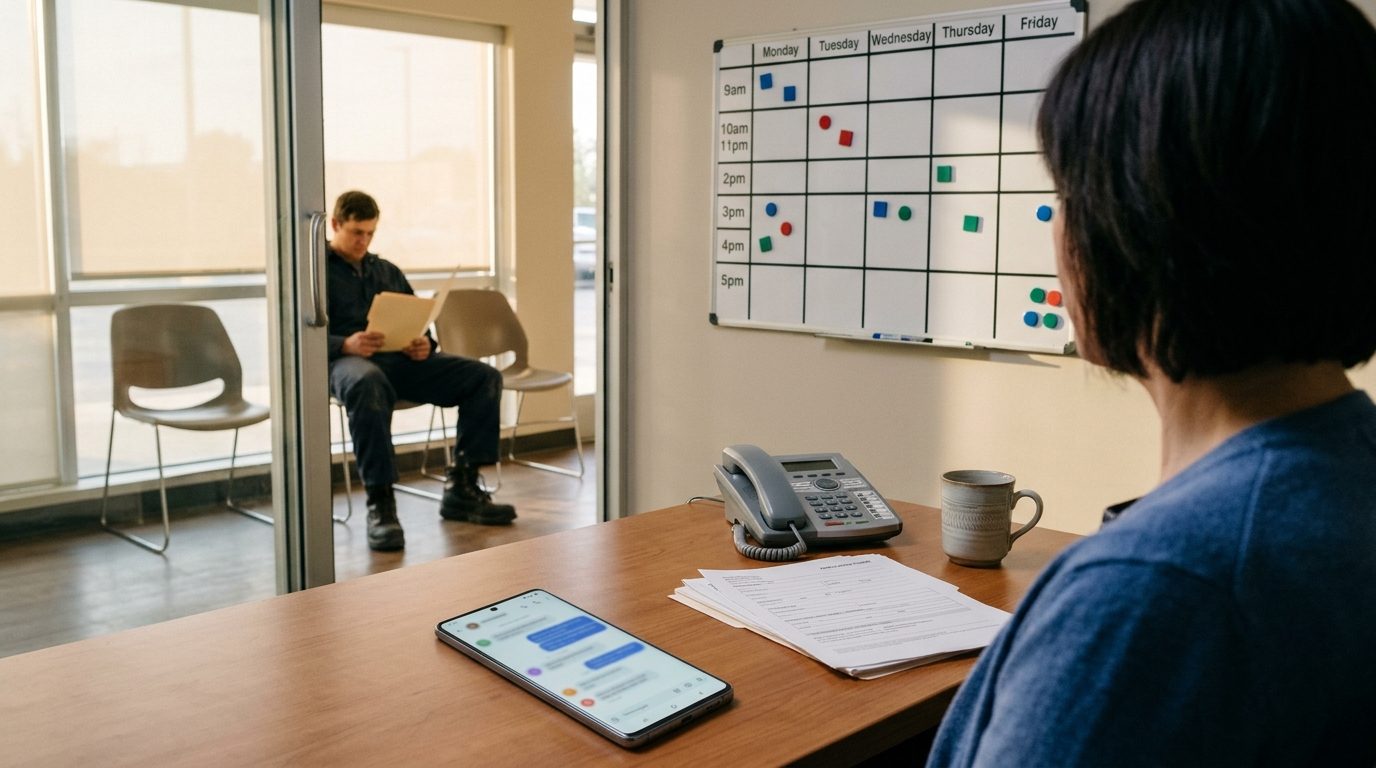
You booked six interviews for Thursday afternoon at the distribution center. The client's HR lead cleared her calendar. Three candidates showed. One texted at 2:10 to say his ride fell through, and the other two said nothing. Friday morning the client asked whether your agency "actually screens anyone," and you spent the day re-sourcing the same req. This is the text sequence that closes the gap between "sure, Thursday works" and the door, from booking to the end of day one, with the templates, the timing, the no-reply rules, and how to measure it. It runs from the recruiter's own Android phone, so the candidate is texting a person they have spoken to, from a number they already have saved.
Why a confirmation and a reminder are two different texts
Most agencies send one "reminder" text and call it done. A reminder is information travelling one way, and it tells you nothing. A confirmation asks the candidate to do one small thing, and whether they do it is the earliest signal you will get about Thursday. So the sequence has two kinds of message. Confirmations ask for a reply and go out early enough that silence still leaves time to act. Reminders carry logistics and go out close enough to the slot that they are still on screen when the candidate leaves the house. Keep the two jobs separate and you get a confirmed list on Wednesday night instead of a surprise on Thursday afternoon.
The leak is not unique to your desk. Indeed's employer survey found most employers have had a candidate skip an interview and most have had a new hire skip day one. Those are self-reported numbers, so track your own show rate instead.
The sequence from booking to the first day
 Times are in the candidate's local time, and every message comes from the recruiter who spoke to them, not a shared agency number.
1. Booking confirmation, within 10 minutes
Trigger: you hang up with the candidate, or the ATS creates the interview. It repeats the details back so a misheard "Tuesday" gets caught today.
Hi Marcus, it's Dana from Ridgeline Staffing. You're booked Thu Oct 23 at 1:30 PM with Pacific Fulfillment, 4120 Industrial Pkwy, Door B. Reply YES to confirm and I'll text the details tomorrow.
No reply after four hours: "Just need a YES so I can hold the slot for you." No reply by the next morning: call once. Still nothing: the client hears from you that the slot is at risk, before Thursday.
2. Day-before confirmation, 3 to 5 pm
Trigger: a scheduled send queued at booking. This one carries the logistics and asks for the reply a second time, because plans change over 48 hours.
Marcus, quick check for tomorrow 1:30 PM at Pacific Fulfillment. Ask for Teresa at the Door B window. Bring a photo ID and wear closed-toe shoes, it's a walking tour of the floor. Still good? Reply YES or tell me if anything changed.
A reply with a problem: reschedule in the same thread and re-run step 1. No reply by 7 pm: "Need a quick YES or NO tonight so I can let Teresa know." No reply by 9 pm: treat it as a likely no-show, tell the client first thing, and offer your backup candidate.
3. Morning-of reminder, two hours before
Trigger: scheduled send. Asks for nothing.
Today 1:30 PM, Pacific Fulfillment, Door B, ask for Teresa. Parking is the gravel lot on the left. Text me if you're running late and I'll let her know.
The running-late line matters: a candidate who is 15 minutes out and embarrassed will often skip rather than arrive late.
4. No-show follow-up, 20 minutes after the slot
Trigger: the client confirms nobody arrived. No guilt in this message; the person who blew off one interview will often still take a shift next week.
Hi Marcus, looks like today didn't work out. No problem. If you still want the Pacific Fulfillment role, I have Mon 10 AM or Tue 2 PM. Reply with one and I'll rebook you.
One reply, one rebook. No reply: tag the contact as a no-show and move them out of the first-call tier for client-site interviews.
5. First-day reminder, 4 pm the day before
Trigger: scheduled send queued the moment the client says yes. It does more than any other message to cut the first-day no-show, because it answers what a new hire worries about: where to park, who to ask for, what to bring.
Tomorrow's your first day at Pacific Fulfillment. 6:00 AM, Door B, ask for Teresa. Bring your ID and the signed I-9 if you haven't sent it yet. Steel-toe boots required. Text me tonight or in the morning with anything at all.
6. End-of-day-one check-in, 30 minutes after the shift
How was day one? Reply 1-5 (5 = great) and tell me anything the supervisor should know.
Most agencies skip this one, and it is the message that catches the quiet quit. A "2" at 3 pm Monday is a phone call tonight, not a client call on Wednesday.
What to do with silence
An unconfirmed interview is a coin flip, and you treat it that way. The escalation path never changes: text, one more text, one call, then the client. Never a third text without a call between, because three unanswered texts mean the number is wrong, the phone is off, or the candidate has decided. The other half of the policy is the backup. For every block of client-site interviews, keep one more screened candidate warm than you have slots. That is who gets the slot when 9 pm passes with no YES.
Who owns the inbox
 The recruiter who booked the interview owns the thread, because the candidate is replying to a person. What a shared inbox adds is cover: when Dana is on a client call at 1:15 and Marcus texts "which door," someone else has to answer inside two minutes.
The setup on Android Texter is one account with every recruiter's Android phone paired to it. Each phone appears in the dashboard as its own device with its own number, and every thread lands in the same web inbox. Dana's threads still come from Dana's number; the front desk can answer the door question while she is on the call. Three more pieces, all in the dashboard:
- Quick replies for the questions that repeat:
/doorfor the address, door and parking line,/bringfor the ID and boots line,/reschedoffering two open slots. - A business-hours auto-reply on each line, so an 8 pm inbound gets "Got it, I'll reply first thing. If it's about tomorrow's interview, call this number."
- Forwarding to a Telegram channel for the weekend on-call recruiter, so a Sunday night "I can't make Monday" reaches a human before 6 am.
Automating the scheduled sends from your ATS
The three messages that ask for nothing (day-before, morning-of, first-day) should never depend on someone remembering. The composer's scheduled-send picker queues them at booking in about a minute. If your ATS fires a webhook when an interview is created, have your middleware call the Android Texter send endpoint with a scheduled_at timestamp for each message and the device_id of the recruiter's phone, so each still comes from the right number. An inbound webhook lets the same middleware mark the interview confirmed the moment the YES arrives. The glue layer is covered in the Zapier and Make.com guides.
Be clear-eyed about the fit. Staffing is not a category the carriers block, and a national firm with a registered brand and a dedicated SMS platform is usually right to stay on a registered A2P provider. The handset is for the branch or the desk, where a few recruiters send a few hundred texts a week and the candidate recognises the number because it is the one they called.
Measuring show rate
 Three numbers, per recruiter, per week, in a spreadsheet with four columns:
- Confirmed rate: interviews with a YES by 9 pm the night before, divided by interviews booked.
- Interview show rate: candidates who walked in, divided by interviews booked.
- First-day show rate: placements who showed on day one, divided by placements made.
Review on Friday and find the leak. A low confirmed rate means sloppy number capture at intake. A high confirmed rate with a low show rate means the door, the parking or the "ask for" line is missing from the message. A low first-day rate means the offer-to-start gap is too long.
Consent, sending hours and STOP
One section, and it changes three things you do.
Get consent at intake. The application form carries a line saying the agency will text about interviews, assignments and shifts, with the mobile number captured beside it, and you keep the record. Interview logistics are not marketing, but treat every candidate text as needing documented consent. The established business relationship article covers what does and does not count.
Stay inside the window. FCC rules bar telephone solicitations before 8 a.m. or after 9 p.m. in the called party's local time. Reminders are not solicitations, but a 9:40 pm text is a complaint waiting to happen, which is why the last message in the ladder goes at 9 pm.
A STOP ends the reminders too. The same rule says consent can be revoked by any reasonable method and must be honored within ten business days. On October 20, 2026, TCPAWorld reported that Coast Dental Services agreed to a settlement valued at up to $3.8 million in cash and vouchers, for a class of 24,308 people who received appointment reminder texts or calls after replying STOP or similar. Reminders, not promotions. Android Texter suppresses STOP, UNSUBSCRIBE, CANCEL, END and QUIT automatically. A candidate who writes "please don't text me" in their own words is on the recruiter to honor; the STOP rules article is the reference.
What the channel changes is the carrier layer: messages go out as person-to-person SMS from a real handset, so there is no 10DLC campaign to register. The TCPA applies exactly as it would through any other provider, and sending from a phone does nothing to reduce that exposure.
Frequently Asked Questions
How far in advance should I send an interview reminder text?
Two messages, not one. A confirmation that asks for a YES between 3 and 5 pm the day before, and a logistics-only reminder two hours before the slot. The first leaves time to rebook if the candidate goes silent. The second is still on screen when they leave the house.
What should I text a candidate who no-showed an interview?
Wait 20 minutes past the slot, then send one message with no guilt in it and two concrete reschedule options: "Looks like today didn't work out, no problem. I have Mon 10 AM or Tue 2 PM, reply with one." If they rebook, run the full ladder again. If they do not reply, tag them and stop.
Do I need consent to text candidates about interviews?
Capture it on the intake form, keep the record, and treat every candidate text as if it needs it. Revocation rules apply to reminders as much as promotions, and the Coast Dental settlement reported this week was over appointment reminders sent after STOP.
Run next week's interviews off this ladder
Pick one client and one recruiter, queue the scheduled reminders at booking, and fill in the four columns on Friday. If you want the shared inbox, the quick replies and the scheduled sends without registering a 10DLC campaign first, Android Texter pairs the recruiter's own Android phone to a web dashboard, and the first text goes out the same day.