
The dialer has run all morning and nobody is picking up, and every attempt that hits voicemail or a wrong number costs the account some of its remaining goodwill. You want to make first contact by text. The catch is that the first text is the one message in the sequence that can land on the wrong person, and once it has, there is no taking it back.
This is the operating procedure for texting first: which accounts qualify, what the first message says, what the replies look like, what you do with silence, and how the reply reaches the collector who owns the file. The rules shape the templates, but they sit in one section near the end.
Decide first: letter first, or text first
Two legal shapes exist, and the choice changes the opening message.
Letter first. You mail the validation notice on day 0 and text a few days later. The letter is the initial communication, so the text only has to say it comes from a debt collector, and it can refer to the letter, which is the best answer to the consumer who assumes the text is a scam. A text that mentions "the letter we mailed on Tuesday" gets answered.
Text first. The text is the initial communication. It carries the full disclosure (that you are attempting to collect a debt and that any information obtained will be used for that purpose), and the validation notice must follow within five days under 12 CFR 1006.34(a)(1). Mail the letter the same day as the text. There is no stripped-down "please call about a personal matter" text that avoids the disclosure: Reg F defines a limited-content message as a voicemail, and the CFPB's Debt Collection Rule FAQs say a message in any other medium does not qualify.
For a floor new to texting, go letter first: the disclosure is shorter and the validation clock is already running.
Qualify the number before anyone types
 The number on the placement file is not automatically one you may text. Reg F's safe-harbor procedures in 12 CFR 1006.6(d)(5) give two routes to a text-eligible number, both with a 60-day freshness condition:
- The consumer texted you from that number about the debt and has not opted out, and within the past 60 days either texted you again or you confirmed through a complete and accurate database that the number has not been reassigned.
- The consumer gave you the number directly for texting about the debt and has not withdrawn consent, and within the past 60 days you obtained or renewed consent or ran the same check.
The CFPB's commentary names the FCC's Reassigned Numbers Database as a qualifying database. In practice this is a field on the account, text-eligible, with a date. A nightly job drops any account whose consent or last database check is older than 60 days out of the text queue until it is refreshed.
Two more filters: run landline detection, and pull any account where the consumer has asked not to be texted, since 1006.14(h) bars a medium the person has asked you not to use. Accounts that fail the gate go to letter and phone.
The first text
Send between 8:00 a.m. and 9:00 p.m. in the consumer's local time, the window Reg F presumes convenient under 1006.6(b)(1).
The first text does three things and nothing else: it names the agency and the collector, asks the recipient to confirm they are the person you are trying to reach, and gives the opt-out method. It does not state the creditor, the balance, or the nature of the debt, because until the recipient confirms their identity you do not know who is reading it.
Template 1, letter-first version (3 to 5 business days after the letter mails):
Hi [First name], this is Dana at [Agency Name], a debt collector. We mailed you a letter on [date] about an account with us. Reply YES to confirm this is you and I'll follow up here, or call [number]. Reply STOP to stop texts to this number.
Template 1, text-first version (letter mails the same day):
Hi [First name], this is Dana at [Agency Name], a debt collector. This is an attempt to collect a debt and any information obtained will be used for that purpose. Ref [number]. Reply YES to confirm this is you, or call [number]. Reply STOP to stop texts to this number.
The text-first version runs to two SMS segments; do not trim the disclosure to fit one. The "Reply STOP" sentence is the opt-out that 1006.6(e) requires in every electronic communication, and the CFPB FAQs give almost exactly that wording as an example.
The replies you will get in the first hour
Five kinds of reply come back. Load a canned answer for each so it reads the same from every desk.
"Who is this?" The most common reply. Answer with identity and a yes-or-no question, still without account details.
Template 2:
This is Dana at [Agency Name], a debt collector. I'm trying to reach [First Last]. If that's you, reply YES and I'll explain here or call you, whichever you prefer. If I have the wrong number, reply NO and I'll remove it. Reply STOP to stop texts.
"Wrong number." Apologise once, confirm removal, then do it: mark the number bad, log the reply and date, and send the account back to skip-tracing.
Template 3:
Thanks for letting me know. I've removed this number and you won't hear from us again. Sorry for the trouble.
"YES" or "What is this about?" Right-party contact is established and the collector who owns the account takes the thread.
Template 4:
Thanks, [First name]. This is Dana at [Agency Name], a debt collector, and I handle your account. The letter mailed on [date] has the full details and your rights. Once you've read it, reply here with questions or to talk through options. Reply STOP to stop texts.
From here, follow our payment plan playbook.
"STOP", "quit", "don't text me." Any of these is an opt-out; the CFPB FAQs say the consumer need not use your exact word. Send a one-line confirmation containing nothing else, which 1006.14(h)(2)(i) permits, then suppress the number in your system of record. No gateway does this for you.
"I don't owe this." Stop the sequence and route the thread to whoever handles disputes.
When nobody replies
Most first texts get no reply. The ladder is short on purpose: Template 1 on day 0 (with the validation letter mailing the same day if text-first), one follow-up on day 7, and on day 14 the account leaves the text queue for the phone or the next letter.
Template 5, day 7:
Hi [First name], Dana at [Agency Name], a debt collector, following up on my text from [day]. A letter with the account details was mailed to you on [date]. Reply YES to confirm this is you, or call [number]. Reply STOP to stop texts to this number.
Reg F's seven-in-seven presumption in 1006.14(b) counts calls, not texts, but the harassment prohibition covers every medium. In New York City, the DCWP rule taking effect January 1, 2027 caps all attempts combined at three per seven days; our SHIELD rule article has the detail.
Getting the reply to the collector who owns the account
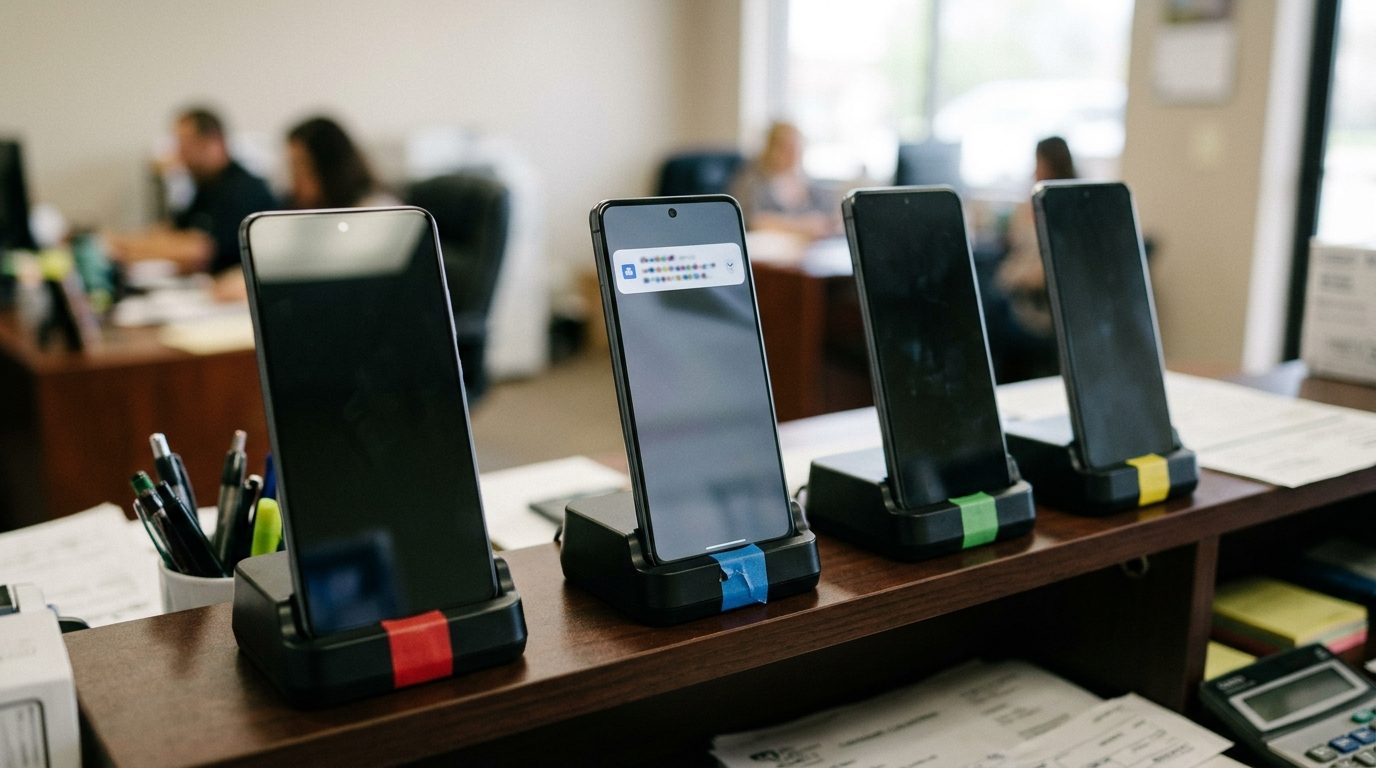 The text goes out from a shared number, the reply lands in a shared inbox, and the consumer's "YES, who is this?" sits for forty minutes while three collectors assume someone else has it. The fix is to make the number the collector's own.
With Android Texter, each collector's Android handset is paired to the agency account as a separate device with its own number, and every send can be pinned to a device. The account owner texts from their own line, so the reply lands on their handset and in the shared web inbox at the same time. The supervisor sees the whole floor; the collector sees their own threads. Nobody has to claim a thread.
A few settings make the floor run. Quick replies hold Templates 2 through 5 as slash shortcuts. Scheduled sends carry the consumer's local-time window, so a collector in Phoenix can queue tomorrow's first texts to a New Jersey placement. Forwarding rules send after-hours replies to the duty supervisor's phone or a team Telegram channel. Webhooks deliver every inbound message, with the device it arrived on, to your collection system, so the reply posts to the right account under the right collector and the STOP and wrong-number replies are logged without anyone keying them.
One honest limit: nothing in the send path checks a prior opt-out. The suppression list lives in your system of record, and it decides whether an account enters the text queue at all.
What to look at on Monday
 Four numbers, by cohort of first-send date:
- Right-party contact rate: confirmed identities over first texts sent, against the same week's phone-first cohort.
- Wrong-number rate: if it climbs, the problem is upstream in number sourcing or the 60-day refresh, not the message.
- Opt-out rate: rising on the first text usually means the text is arriving before the letter.
- Time to first human reply: over fifteen minutes in business hours means routing is broken, not staffing.
Hold the wording constant for a month, or the numbers will not mean anything.
The rules that shaped these templates
None of this is legal advice; counsel approves the wording before it ships. Behind the design: the disclosure rules in 1006.18(e), the opt-out and number procedures in 1006.6, the 8:00 a.m. to 9:00 p.m. window, and the five-day validation notice, sent in a manner reasonably expected to give actual notice under 1006.42; mailing to the last known address is the safe harbour.
The TCPA applies in full. Texts are calls under the TCPA; a magistrate judge in the Eastern District of California held so again in Lewis v. Tenth Hall on October 21, 2026, as TCPAWorld reported. Consent to text a wireless number is yours to obtain and document, and a handset does not change that; our opt-out rules article covers what counts as revocation.
Frequently Asked Questions
Can the very first contact with a consumer be a text message?
Yes. Reg F does not require a letter or a call first. If the text is the initial communication it must carry the full attempt-to-collect disclosure, include an opt-out method, and be followed by the validation notice within five days. Many agencies mail the notice first and text afterwards, which gives the text a letter to refer to.
Why not put the creditor and balance in the first text?
Because you do not yet know who is reading it. Until the recipient confirms their identity, a message naming the creditor and the amount is a third-party disclosure risk if the number has changed hands. The first text establishes who you are and asks who they are; the details follow once the right party has answered.
Does sending from a handset change my TCPA obligations?
No. Texts are calls under the TCPA, and consent to text a wireless number is yours to obtain, document and honour whatever device sends the message. A handset keeps the channel out of carrier A2P 10DLC category vetting, which is a deliverability question, not a legal one.
Run first contact from your collectors' own lines
Third-party collections is one of the categories A2P 10DLC vets hardest. Android Texter routes each collector's texts through their own Android handset as person-to-person SMS, pairs every handset into one shared inbox, and provides the quick replies, scheduled sends, forwarding rules and webhooks above. Reg F, the TCPA and your consent records stay entirely yours. Pair the first handset and run the day-0 text this week.