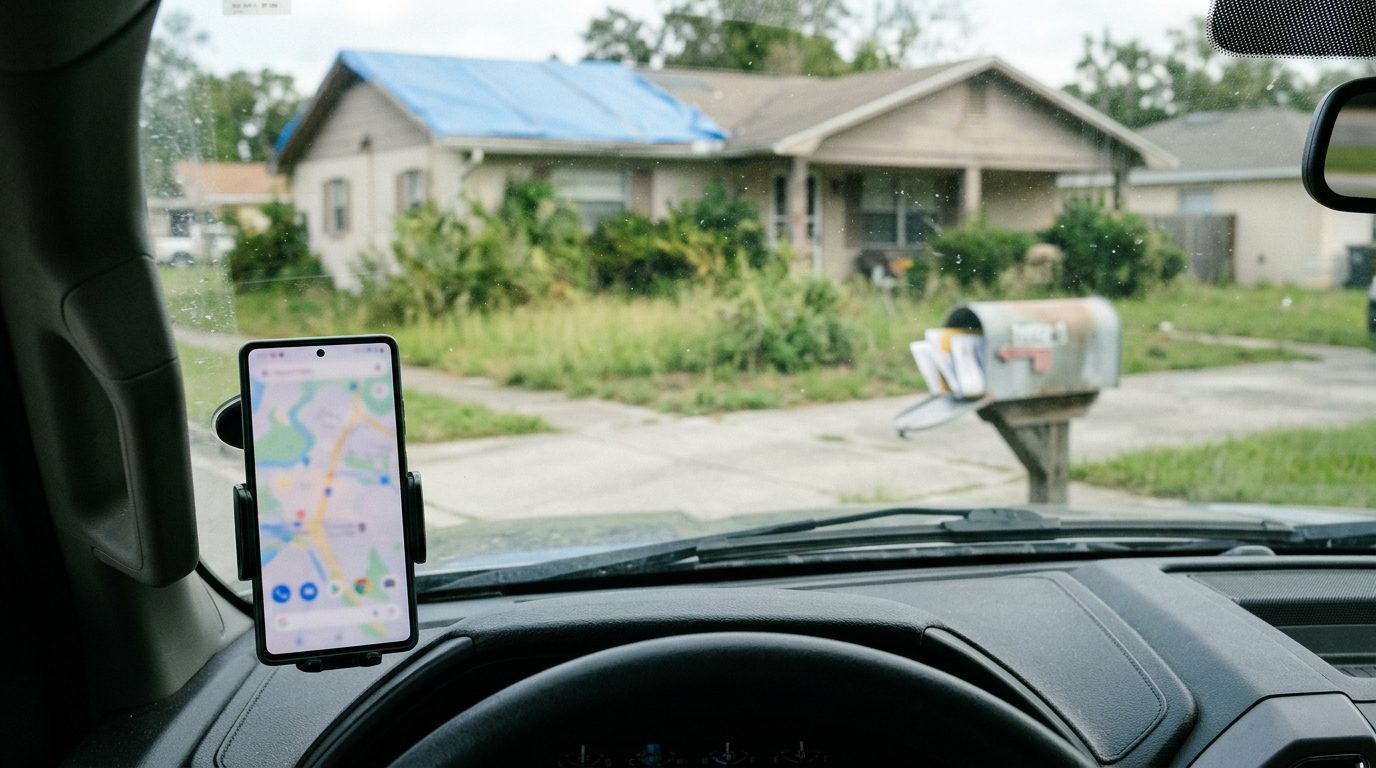
You drove a route on Saturday. You have sixty photographs of tired houses in your phone: a tarp on one roof, mail piled against a door, a lawn nobody has cut since July. By Monday the app has given you owner names, mailing addresses and a handful of phone numbers each. The question is how a photograph becomes a conversation.
Most texting advice is written for purchased lists, where the first message has nothing to say except "do you own this." You stood in front of the house. Here is the week that gets from the curb to a seller on the phone.
The week, from the drive to the inbox
A driving for dollars list is small and fresh, and the rhythm follows from that.
- Saturday: drive. Capture properties with photos and condition tags.
- Sunday or Monday: trace. Pull owner records and phone numbers. Split owner-occupants from absentee owners, which the mailing address tells you.
- Monday: scrub and segment. Remove landlines, scrub against the National Do Not Call Registry and any state list you must use, tag what survives by route.
- Tuesday to Thursday: send and answer. First texts go out spread across the day. Every reply gets a human within fifteen minutes.
- Friday: sort. Every record gets a status back in the driving app: wrong number, keeper, maybe, appointment set, under contract.
A text that says "I drove past on Saturday" is credible on Tuesday and strange three weeks later, so the whole list is worked within the week.
What to capture at the curb
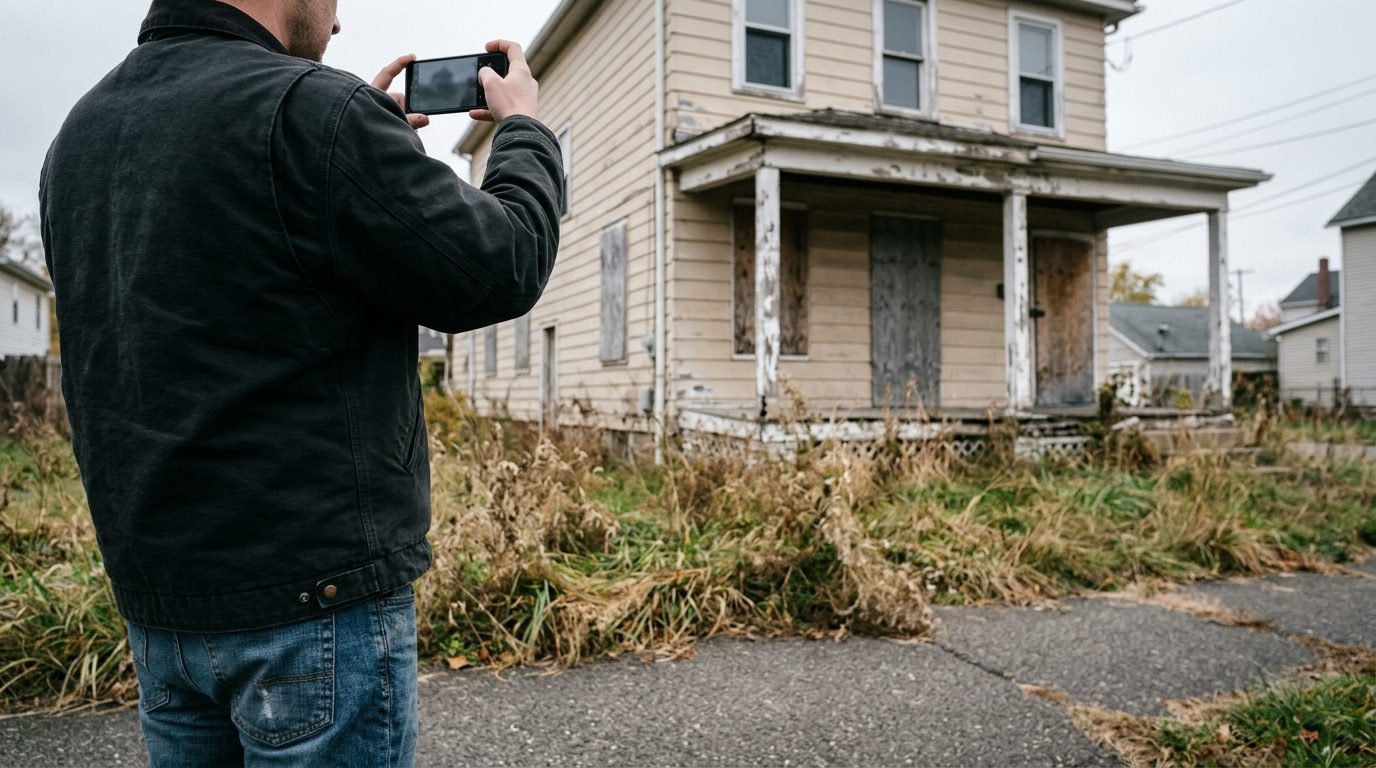 The first text is only as good as what you noted while standing there. Capture two things per property.
A photo of the house, framed so you recognise it again. You will not send it to anyone; you will look at it before you text, so you describe the right house.
Condition tags, from a short fixed vocabulary: tarp, boarded, overgrown, mail piling, code notice, vacant. DealMachine's feature overview describes route tracking that "automatically tracks your routes, ensuring you don't drive the same streets twice" with owner contact lookup bundled into the plan. PropStream's features page lists a Driving for Dollars mode in its mobile app and skip tracing with "built-in DNC and litigator alerts." A spreadsheet with a photo column works too. What matters is that the tag you wrote down is the thing you mention in the text.
From a skip trace to a list you can text
A skip trace returns several numbers per owner, of varying age and quality. Three steps before anyone sends.
Rank the numbers. Mobile first, most recently seen first, one number per owner. If it comes back wrong, move to the next. Texting all four at once annoys three strangers to find one owner.
Remove landlines. They cannot receive SMS and look like a dead list. Android Texter's contact import supports carrier and landline detection through its Landline Remover integration.
Scrub the registry. Texts to a wireless number are covered by the federal do-not-call rules: 47 CFR 64.1200(e) applies them to telemarketing "text messages to wireless telephone numbers." The registry is accessed through telemarketing.donotcall.gov, sold by area code with the first five free, and the FTC says you "must synchronize your lists with an updated version of the registry at least every 31 days" (FTC Q&A). More in Does Texting the Do-Not-Call List Violate the TCPA?
Then tag by route, something like elm-route-nov8, so a reply three days later points you to the right photograph.
The first text, when you have actually seen the house
 A driving list lets you name the thing you saw. The first message confirms ownership, says who you are, references the property, and asks for nothing else.
Template 1: owner-occupant opener. Trigger: scrubbed record, best mobile number. Send between 10 a.m. and 6 p.m. in the owner's local time.
Hi, this is Dana with Ridgeline Home Buyers. I drove past 412 Elm St on Saturday and noticed the tarp on the roof. Are you the owner? If I have the wrong number just say so and I'll remove it. Reply STOP to opt out.
Template 2: absentee owner opener. Trigger: mailing address differs from the property address, so the owner may not have seen the house in a year. Same window, in the time zone of the mailing address.
Hi, this is Dana with Ridgeline Home Buyers. I was on Elm St in Dayton on Saturday and the house at 412 looks like it's been sitting empty a while. Are you still the owner? Wrong number, just tell me and I'll remove it. Reply STOP to opt out.
Neither message contains "cash offer," a dollar figure, a link, or a question about selling. The only question is whether you reached the owner, and people answer that.
Template 3: wrong number. Trigger: any reply saying this is not the owner. Send immediately. It is the most common reply you will get.
Thanks for letting me know, I've taken this number off my list. Sorry for the interruption.
Mark the number dead in the driving app and try the next one. Do not ask the stranger who owns the house.
Template 4: the single nudge. Trigger: no reply after four days. Send once, in the morning, as a scheduled message set when Template 1 went out.
Hi again, Dana from Ridgeline. No pressure at all on 412 Elm. If it's a keeper, just say so and I won't text again. If you'd ever want to know what someone would pay for it as-is, I can get you a number this week.
No reply to the nudge means stop; two unanswered cold touches is the limit. The record moves to the 30, 60 and 90 day check-ins we laid out message by message in the seller follow-up playbook.
From reply to appointment
 Replies fall into five buckets, and whoever runs the inbox needs a quick reply saved for each.
- STOP, or any variant. Confirm once, add the number to your suppression list, never text it again. Android Texter can match the keyword with an auto-reply rule and send the confirmation, but it does not keep a suppression list for you. That list is yours to build and honour.
- Wrong number. Template 3, then the next number.
- Keeper. "Thanks for letting me know, I'll leave you be." Mark it and leave it.
- Owner, curious. Reply by hand within fifteen minutes and move toward a call.
- Owner, hostile. Apologise once, mark do-not-contact.
Template 5: the handoff to a call. Trigger: owner confirms and shows any openness ("depends on the number," "maybe next year"). Reply by hand, but the shape is always the same.
Appreciate it. I buy houses in that part of Dayton as-is, no repairs and no listing. To give you a real number I'd need ten minutes on the phone and a quick look inside. Is this afternoon or tomorrow morning better for a call?
Once a walkthrough is booked, confirm it by text right after hanging up and schedule a one-line reminder for 8 a.m. on the day. Every message should come from the number the owner first replied to. On Android Texter each paired handset is its own device with its own number, and a send can be pinned to a device, so the seller always sees the same ten digits.
Who owns the inbox. In a one-person shop the driver is the texter. With two people, the acquisitions manager takes the curious-owner bucket and everything else stays with whoever runs the list. A driving list cools by the hour once an owner replies and hears nothing.
Sizing the sends on paired handsets
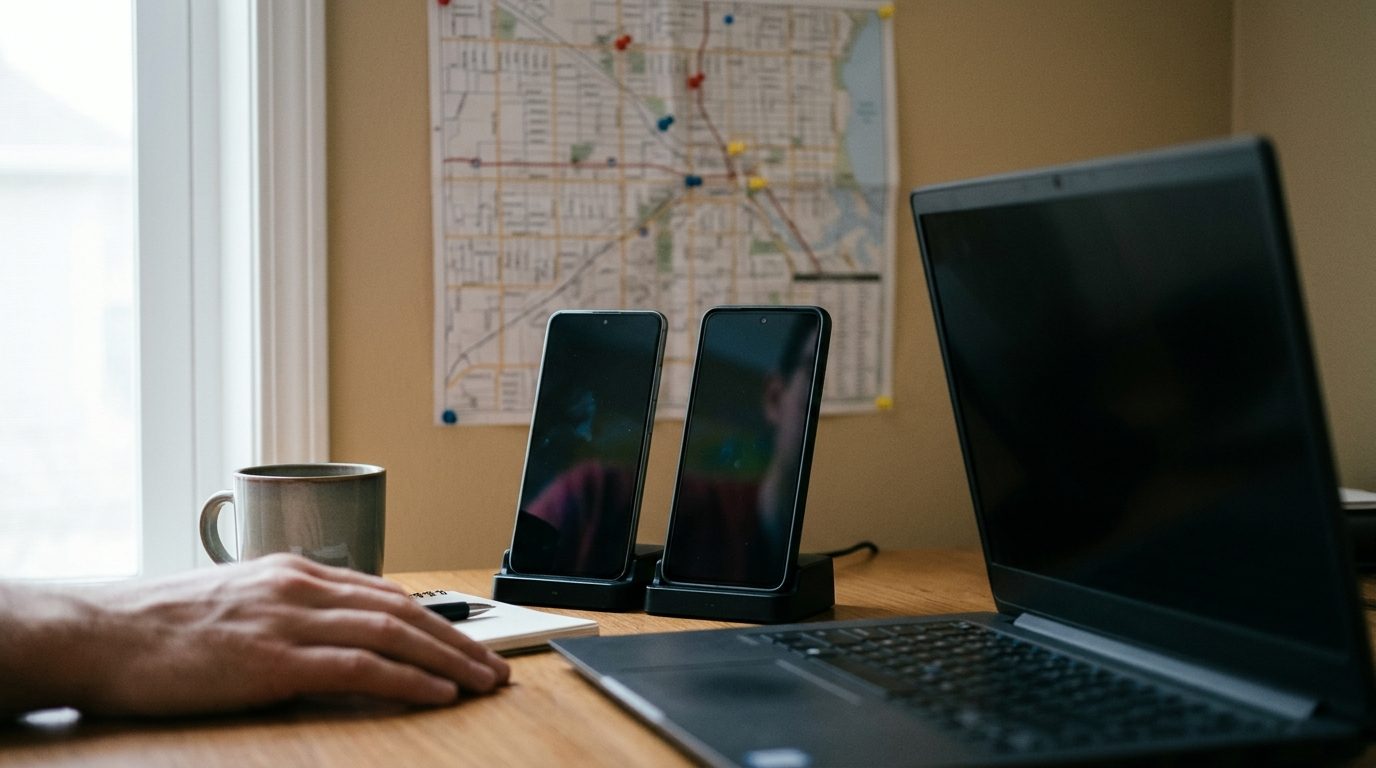 A driving list is not a volume problem. Sixty properties with one or two textable numbers each is a hundred messages, an ordinary day for one line. The point is to keep each line's day looking like a person's day: sends spread across morning and afternoon, replies interleaved, nothing resembling a hundred identical texts at nine o'clock.
Operators running larger lists use three to five paired Android phones at roughly 100 to 200 sends a day each; a driving operation needs one or two. The per-line mechanics are in SMS Sending Limits Per Phone Number. Two choices matter:
- Pin, don't round-robin, for sellers. Round-robin suits a buyer broadcast. For sellers, pin each owner to one device so the conversation never jumps numbers.
- Schedule the nudge and the reminder at the moment you send the message before them, so neither depends on a busy Thursday.
To judge a route, count properties captured, numbers that survived the scrub, right-owner replies, appointments and contracts.
The rules that change what you send
None of this is legal advice, and nothing about the channel changes it.
Hours. 47 CFR 64.1200(c)(1) prohibits telephone solicitations before 8 a.m. or after 9 p.m. local time at the called party's location. For an absentee owner that is where they live, not where the house is.
The registry, and a ruling you will hear about. On October 14, 2026 a magistrate judge in the Southern District of Texas held in Siringi v. Crust Pizza that SMS messages are not "telephone calls" for the TCPA's do-not-call provision, as reported by TCPA World on November 12. The same report notes the ruling has not been adopted by the district judge and that every other court on the question has gone the other way. Nothing about your Monday scrub changes.
Opt-outs. 64.1200(d)(3) requires a do-not-call request to be recorded when made and honoured within at most ten business days. Treat it as immediate.
Consent posture. Cold outbound to skip-traced owners is the highest-risk consent posture in this industry, and class actions target wholesalers for it. State mini-TCPAs add their own rules. We covered it in Real Estate Wholesaling SMS Compliance: What Actually Works.
What Android Texter does and does not change. Messages sent through a paired Android handset are person-to-person SMS from a real carrier line, so they are not subject to the A2P 10DLC campaign classification that filters "we buy houses" traffic at the aggregators, usually with no signal back. The TCPA, the do-not-call rules and state law apply to every message exactly as they would through any other provider.
Frequently Asked Questions
How many of the skip-traced numbers should I text?
One at a time, best mobile number first. A wrong-number reply is normal and useful: remove the number, mark it in the driving app, try the next. Texting every number at once reaches three strangers to find one owner, and the strangers are the ones who complain. Landlines should never be in the send list at all.
Should the first message mention a cash offer or a price?
No. The first text confirms ownership, identifies you and names the property. Owners reply to "are you the owner of 412 Elm" far more readily than to a stranger quoting a price for a house they have not decided to sell. The offer conversation belongs on the phone, after they have confirmed who they are.
Does the registry still apply to texts after the Texas ruling?
Treat it as yes. It is a single magistrate judge's decision not yet adopted by the district judge, and TCPA World reports that every other court on the question has held the opposite. The FCC's rule text applies the do-not-call provisions to text messages. Keep scrubbing every list at least every 31 days.
Run next Saturday's route through a phone you own
A driving for dollars list is small, fresh and personal. Android Texter pairs your Android handsets to one web inbox, pins each seller to a single number, schedules the nudge and the reminder, and tags every contact by route. Pair a phone, import Monday's scrubbed list, and send Tuesday's first texts from a number the owner can call back. Start at androidtexter.com.