
GivingTuesday is December 1 this year, three weeks out. The email appeal is drafted. The thing you have not planned is the texting. You have a few hundred donor mobile numbers in the CRM and a small team, and somebody is going to send texts on December 1 from somebody's phone. The open questions are what they say, when they go, who watches the replies, and what happens in the thirty days after, when most of the money actually arrives.
This is that plan: the week before GivingTuesday to the afternoon of December 31, with the templates, the segment each one goes to, and the wait before the next.
Why December 1 is the start, not the finish
Texting donors is a small-list, high-attention channel. The 2026 M+R Benchmarks study, covering 2025 data from 180 nonprofits, puts the median mobile list at 176 subscribers per 1,000 email subscribers, getting 7.3 fundraising texts a year at a 0.17 percent response rate. The timing is the point. Nonprofits received 37 percent of all 2025 online revenue in December, with the last week of the year accounting for 10 percent of annual revenue and December 31 alone for 4 percent. The GivingTuesday Data Commons estimates $4.0 billion was donated in the US on December 2, 2025, up 13 percent. So plan the texts as one sequence through the 31st, with the GivingTuesday sends as its first three.
Four tags before you send anything
 Tag every donor with a mobile number into one of four groups, in the Android Texter contact tag field or a CRM field you export from.
- recurring: monthly donors. No ask on GivingTuesday, just thanks and a share request.
- last-year: gave in the last twelve months, not recurring. The core appeal list.
- lapsed: gave before, nothing in twelve months. A softer first message.
- gt-first: first gift ever came on GivingTuesday last year. They respond to the day.
Add a fifth tag, do-not-text, and make it a rule that anyone carrying it is removed from every broadcast list before a send. Android Texter does not do this for you: nothing in its send path checks for a prior STOP, so the suppression list is yours to maintain, and the tag is how a small team does it.
The calendar: seven sends, November 24 to December 31
Times are the recipient's local time. The scheduled-send picker in the composer takes a timestamp, so you can queue the whole calendar in one sitting and edit it later from the scheduled messages page.
| Send | When | Goes to | Purpose |
|---|---|---|---|
| 1. Save the date | Tue Nov 24, 10:00 | last-year, lapsed, gt-first | Warm the number, confirm opt-in |
| 2. Launch | Tue Dec 1, 08:30 | last-year, gt-first | The ask, with the link |
| 3. Lapsed launch | Tue Dec 1, 09:30 | lapsed | Same ask, different first line |
| 4. Afternoon update | Tue Dec 1, 16:30 | non-givers from 2 and 3 | Progress, second ask |
| 5. Recurring thanks | Tue Dec 1, 12:00 | recurring | Thank, no ask, request a share |
| 6. Mid-month | Tue Dec 15, 10:00 | non-givers so far | One update, light ask |
| 7. Year-end close | Dec 30, 10:00 and Dec 31, 14:00 | non-givers, plus last-year who gave on GT | Deadline |
Seven sends in five weeks is about what M+R's median nonprofit sent in a year, which is why this list should be quiet for the other eleven months.
The templates
Each one is under 160 characters so it goes as a single SMS. On a broadcast through the API or the Zapier app, the first-name token resolves against the contact record, with a fallback for unnamed contacts.
Send 1, save the date. Trigger: one week out. Wait: nothing until December 1. On "who is this?", give your name and the organization and offer to remove them. On STOP, tag do-not-text within the hour.
Hi {{first_name|there}}, it's [Your name] at [Org]. GivingTuesday is Tue Dec 1 and we'll text you once that morning with the link. Reply STOP anytime to opt out.
Send 2, launch. Trigger: 08:30 on December 1. Wait: eight hours. A gift takes them out of the sequence and into the thank-you. A question gets a human answer from the inbox within fifteen minutes.
Good morning {{first_name|friend}}, it's GivingTuesday. Every gift to [Org] today is matched up to $[amount] by [Match sponsor]. Give here: [link]. Reply STOP to opt out.
No match? Do not invent one; name what a gift buys.
Send 3, lapsed launch. An hour later, so the inbox does not take both waves at once. The first line acknowledges the gap without apologizing.
{{first_name|Hi}}, it's [Your name] at [Org]. You helped us in [year] and I wanted you to see what that built: [link]. Today's GivingTuesday gifts are matched. Reply STOP to opt out.
Send 4, afternoon update. Trigger: 16:30, non-givers only, and only with a real number. A made-up "almost there" is the message that gets a STOP.
Update from [Org]: [number] people have given today and we're at $[total] of our $[goal] goal. The match runs until midnight: [link]
Send 5, recurring donors. Midday, no ask. The fastest way to lose a monthly donor is to treat them like a prospect on the day the whole sector is asking.
{{first_name|Hi}}, it's [Your name] at [Org]. No ask today. Your monthly gift is why we can do this at all. If you want to help, forward this to one person: [link]. Thank you.
Send 6, mid-month. December 15, non-givers only. Many donors skip GivingTuesday and give in the last week; this keeps the thread alive without pressing.
{{first_name|Hi}}, quick update from [Org]: GivingTuesday gifts put [specific result] in motion. If you'd like to be part of the year-end push, here's the link: [link]
Send 7, year-end close. December 30 carries the deadline and the tax line; December 31 is a short final call. Both go to non-givers; the first also goes to last-year donors who gave on GivingTuesday, since a second December gift is common from that group.
[Org] year-end: gifts made by midnight Dec 31 count toward your 2026 tax year, and we're $[gap] short of our goal. Give here: [link]. Reply STOP to opt out.
Last call from [Org]: 10 hours left in 2026. [link]. Thank you for a year of support, whatever you decide.
The thank-you after a gift is its own sequence: the donor thank-you playbook covers it. Send the first one as a personal text from the inbox, not a broadcast.
Who owns the inbox on December 1
 One named person owns replies all day, usually the development director, with the ED as backup after 18:00. Everyone else stays out, because two people on one thread means a donor hears two stories about the match.
Build the quick-reply set the week before; the usage counter shows which ones to keep for December 31:
- /receipt: "Yes, your gift went through and the receipt went to [email]. If it hasn't arrived in an hour, reply here and I'll resend it."
- /stop: "Done, you won't hear from us by text again. Thank you for everything you've given." Send it, then tag the contact do-not-text before doing anything else.
If the owner leaves the laptop, a forwarding rule mirrors inbound to their handset or a Telegram channel. Fifteen minutes is the target: a donor who asks "did it go through?" and waits an hour may not give on the 31st.
What to do with silence
Most people will not reply and most will not give from the text. At a 0.17 percent response rate that is the normal shape of the channel. The calendar already holds every follow-up a non-giver should get; do not add to it. Six texts in five weeks with no reply is an answer, and the right move is to rest the list until spring.
Two exceptions. A number that returns a carrier error on November 24 is dead or a landline; drop it before December 1. A contact who asked a question after the save-the-date is warm: the owner opens their thread first on the 1st and adds one personal line above the broadcast copy.
Sending from a phone: where it fits and where it does not
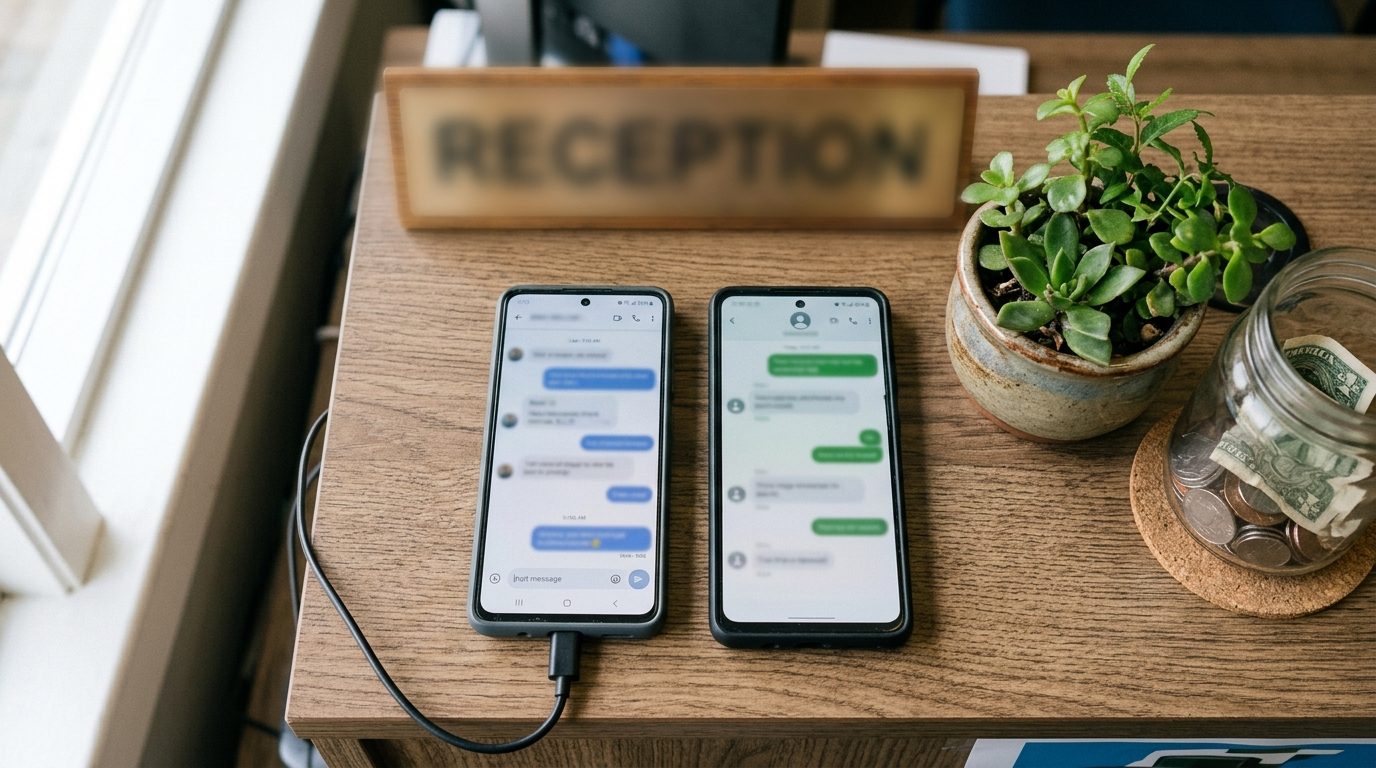 Nonprofits are not a blocked category. Most can get an A2P 10DLC campaign approved, and if the plan is 5,000 texts in the first hour of December 1, a registered platform is the right tool. A handset on a consumer line sends roughly 100-200 messages a day before carrier velocity filters bite; see where those limits come from.
A phone is good for the list in this article: a few hundred donors, five weeks of sends, replies that need a human. Donors may recognize the number from a thank-you call, replies land in one shared inbox, and there is no registration, vetting or monthly fee. If the list outgrows one line, pair a second Android handset, typically the front-desk phone and the ED's phone on one account, so the broadcast splits across two carrier lines. For the comparison with a broadcast platform, including where the platform wins, see Mobile Text Alerts and Android Texter.
Consent and opt-out, the short version
None of this changes what the law requires, and we do not give legal advice. Three points change what you send.
Consent. Texting a donor's mobile number with an automated system requires prior express consent. The FCC's rules treat tax-exempt nonprofits differently: their messages fall outside the definition of "telephone solicitation" in 47 CFR 64.1200(f)(15), so the National Do Not Call rules do not apply, and for marketing-type automated messages a nonprofit needs prior express consent rather than the signed written consent a business needs. It still needs consent: a checkbox on the donation form saying you will text them, the number captured beside it, and a record of when it was ticked.
Opt-out. The same rule lets a recipient revoke by any reasonable method, names STOP, QUIT, END, REVOKE, OPT OUT, CANCEL and UNSUBSCRIBE as reasonable per se, and requires revocations be honored within ten business days. Honor it the same hour, because the do-not-text tag is the only thing between that donor and the December 30 broadcast. See our post on what counts as STOP for the edge cases.
The courts. A November 3 webinar recap on AccountsRecovery.net notes the Seventh and Ninth Circuits disagree on whether a text is a "call" under some TCPA provisions. Keep documenting consent and honoring opt-outs as if it were settled against you.
Frequently Asked Questions
How many texts should a nonprofit send on GivingTuesday?
Two to the core appeal list, a morning launch and a late-afternoon update, plus a midday thank-you to recurring donors with no ask in it. Skip a "final hours" message unless you have a true figure to report. The year-end messages still have to land, so spend the list's patience carefully.
Should recurring donors get the GivingTuesday ask?
No. Monthly donors already said yes, and a public-ask day is when they are most likely to feel taken for granted. Send a thank-you with no give link and a request to forward the appeal to one person. If they want to give extra they will, and the share often reaches a donor a broadcast would not.
Do nonprofits need 10DLC registration to text donors?
Through an aggregator-based platform, yes, and most nonprofits can get a campaign approved. Through a user-owned Android handset, no, because the traffic is person-to-person SMS from a consumer line rather than registered business messaging. A list of a few hundred with real conversations suits the handset; a high-volume blast list belongs on a registered platform.
Run December from one inbox
If your donor list fits in one person's working day and the replies deserve a human, Android Texter runs this calendar from a phone your organization already owns: tag the segments, schedule the seven sends, and watch December 1 and December 31 from one inbox. Start at androidtexter.com and have the save-the-date queued before November 24.