Every branch has the same quiet asset sitting in its loan management system: the customers who borrowed, paid in full, and left. They know the store, and you know how they repay. Many will be short again within the year. Whether they walk back into your store or into the one across the road often comes down to who they heard from last.
Most shops either never contact a paid-off customer again, or blast the whole closed-loan file with the same "need cash?" line every Friday until the list stops answering. This playbook sits between the two: a short, timed sequence of payday loan customer retention texts, who gets each one, who answers the replies, and how to tell whether it is working.
Start with the paid-off list, and cut it hard
 Pull every closed loan from the last 12 months and sort it before you write any copy. The sorting matters more than the wording.
Text these customers:
- Paid in full, on time or within a few days of the due date
- Gave written consent to marketing texts at application (more on that near the end)
- Have never replied STOP or asked a clerk to stop texting them
Never put these on the list:
- Anyone with an open balance, a returned payment, or an account in collections. They belong in your due date sequence.
- Anyone who has opted out, by text or in person
- Anyone whose file shows consent to account messages only
Then tag what is left by recency, because the message changes with the gap:
- Recent: paid off in the last 90 days. They remember your name and probably the clerk's.
- Lapsed: 3 to 12 months. They remember the store but may have gone elsewhere since.
- Cold: more than 12 months. Leave these out of the routine sequence.
How far back is worth texting? Twelve months is a sensible ceiling for a first pass, for two practical reasons. Phone numbers change hands, and a prepaid number that was your customer's two years ago may belong to a stranger now. The FCC runs a Reassigned Numbers Database for exactly this problem. And a customer who has not thought about your store in two years reads your text as coming from a stranger.
The four-message sequence
Four messages across roughly a year, each with a single trigger. Nobody gets a second nudge for ignoring the first.
Message 1: the payoff thank-you
Trigger: final payment clears. Send: same day, during store hours. Offer: none.
Hi Dana, it's Maria at QuickCash on 5th. Your loan is paid in full as of today and your account is closed. Thanks for handling it the way you did. Reply STOP to opt out of texts from us.
This confirms the payoff in writing, which cuts the "am I all paid up?" calls, and puts a named person and a real number in the customer's phone. It asks for nothing. In some states you could not lend to them today anyway (see the rules section).
Message 2: the 30-day check-in
Trigger: 30 days after payoff, for the Recent tag only. Send: mid-morning on a weekday. On no reply: do nothing.
Hi Dana, Maria at QuickCash on 5th. You're in good standing with us, so if something comes up, your info is already on file and a new application takes a few minutes. Text me here with any questions. Reply STOP to opt out.
Thirty days is a starting point. If your own data shows returning customers come back at six or eight weeks, move the trigger. The copy promises no approval, states no amount, and invents no urgency. It tells a good customer the door is open and gives them a person to ask.
Message 3: the seasonal note
Trigger: a calendar moment when your branch sees more demand. Late November into December, the back-to-school weeks, and the stretch in January before tax refunds arrive are the obvious ones. Segment: Recent and Lapsed. Limit: one message per season, and skip anyone who received Message 2 in the last two weeks.
Hi Dana, Maria at QuickCash on 5th. We're open normal hours through the holidays, closed Thursday only. If you need us before the 1st, you can apply in store or text me and I'll tell you what to bring. Reply STOP to opt out.
The message leads with useful information (holiday hours) and does not suggest borrowing for gifts. A loan pitched as holiday spending money draws the wrong attention from regulators and writes the wrong kind of loan for your book.
Message 4: the lapsed reintroduction
Trigger: six months since payoff with no new loan. Send: once. On no reply: move the contact to Cold and stop.
Hi Dana, this is Maria at QuickCash on 5th St. You had a loan with us earlier this year and paid it off. Just letting you know we're still here if you ever need us. If you'd rather not hear from us, reply STOP and I'll take you off the list.
The lapsed customer may not have your number saved, so the message reintroduces the store and makes leaving easy. Expect more opt-outs here than from the Recent tag. That is the list cleaning itself.
What happens when they reply
 Past borrowers reply with a narrow set of questions. Build a quick reply for each before the first send:
- "How much can I get?" It depends on a new application and current income. Never quote an amount from the old file.
- "What do I need to bring?" Your document list: ID, proof of income, bank statement, whatever your state and your underwriting require.
- "Not right now." A one-line thanks, and no further messages until the next scheduled trigger.
- "Who is this?" Store name, address, and the fact that they were a customer. If they still do not recognize you, treat it as a wrong number and remove it.
One named person owns the replies, usually whoever signed the texts. If Maria's name is on the message, Maria (or whoever is covering her counter) answers within the hour during store hours.
A customer who says yes leaves this sequence for your normal application flow. If they start an application and stall, see the 24-hour application follow-up playbook.
Running the sequence from one handset
 Business texting platforms route through A2P 10DLC, the carrier registration system, and payday lending is one of the categories it refuses or throttles regardless of what the message says. We covered the mechanics in why payday lender SMS delivery stalls.
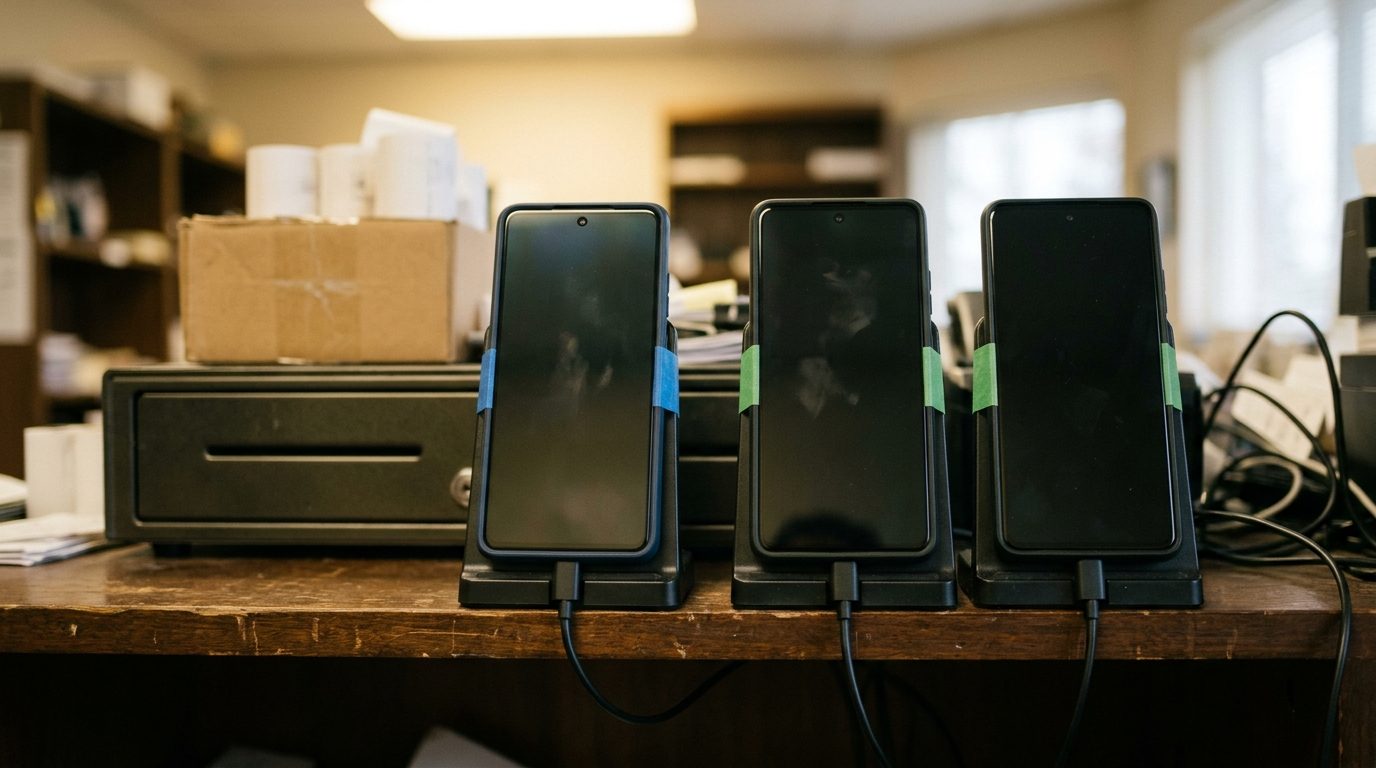
Android Texter sends through an Android phone you own, on that phone's carrier line, as person-to-person SMS from a real 10-digit number, with no campaign to register. For this sequence you would use:
- Contact tags. Tag contacts Recent, Lapsed, and Cold, and update the tag when the loan status changes.
- Scheduled messages. When a loan closes, schedule Message 2 for 30 days out and Message 4 for six months out. Cancel them from the scheduled queue if the customer takes a new loan or opts out.
- Broadcasts with name tokens. The seasonal note goes to a tagged group as a broadcast, with
{{first_name|there}}filling the name so it does not read as a blast. - Quick replies. The four answers above become slash shortcuts in the composer.
- A shared inbox. Replies thread by conversation in the web dashboard, so the clerk at the counter sees the history before answering.
Two operating notes. Pace the seasonal broadcast: a personal line sending hundreds of messages in a burst looks like spam to the carrier, so split a large list across several days or across paired phones. And if your branch also texts past-due accounts, pair a second handset and pin collections traffic to it, so complaints about collections messages do not attach to the number your good customers have saved.
One limit: Android Texter does not keep a suppression list for you. An auto-reply rule can confirm a STOP, but removing that customer from your tags and cancelling their scheduled messages is your job, the same day.
What to measure each month
Four numbers, tracked per message and per tag:
- Replies per message sent. Tells you whether the copy reads as a person or a promotion.
- Applications started by customers who received a message in the last 14 days.
- Loans funded from those applications. This is the only number that pays the rent.
- Opt-outs per message. If one message produces most of your STOPs, rewrite it or retire it.
If the Lapsed tag produces opt-outs and no loans, shorten the lookback from 12 months to 9.
The rules that change what you send
None of this is legal advice. Four rules shape the sequence above.
Consent. A re-borrow offer is a marketing message. Under the TCPA rules, marketing texts sent with an autodialer require prior express written consent, and that consent cannot be a condition of getting the loan. Having been your customer is not consent on its own, a point we covered in whether an established business relationship covers texts. Sending from a handset changes the carrier gate. It does not change the TCPA, and it does not reduce your exposure under it.
Hours. The same rules bar telephone solicitations before 8 a.m. or after 9 p.m. in the recipient's local time, and they apply to texts to wireless numbers. Sending during store hours keeps you inside that window.
Opt-outs. A reply of stop, quit, end, revoke, opt out, cancel, or unsubscribe is a valid revocation, and the FCC rule requires it to be honored within a reasonable time not to exceed ten business days. The FCC amended parts of this rule in late 2026, so confirm the current text with counsel. In practice, same day is the right standard.
State lending law. This is why Message 1 carries no offer. Florida, for example, prohibits rollovers and bars a new deferred presentment transaction within 24 hours after the previous one ends. Other states set their own limits. Have counsel read your templates against your state's statute before the first send.
Frequently Asked Questions
How often should a payday lender text past borrowers?
Far less often than most do. The sequence here is four messages across a year: a payoff thank-you, a 30-day check-in, one seasonal note, and one reintroduction at six months. Each has its own trigger, and silence is never followed by a reminder. A past borrower who hears from you weekly learns to ignore the number or reports it.
Can I text a past customer about a new loan without their consent?
Do not assume so. A re-borrow offer is marketing, and marketing texts generally require the customer's prior written consent under the TCPA rules, however the message is sent. A past loan is not consent by itself. Check what your application form actually captured, keep that record, and leave anyone without marketing consent off the list.
Should re-borrow texts and collections texts come from the same number?
No. Collections messages draw more opt-outs and complaints, and that history attaches to the sending number. Keep origination and retention on one line and past-due accounts on another. With Android Texter you can pair two handsets to one account and pin each type of message to its own device while replies land in one inbox.
Put the paid-off list to work
Sort the closed-loan file, load the four messages, give one person the inbox, and count funded loans at the end of the month. If your current SMS provider will not carry a lender's traffic, Android Texter sends the same sequence from a phone you own, with the consent records and opt-out handling staying where they belong: with you.