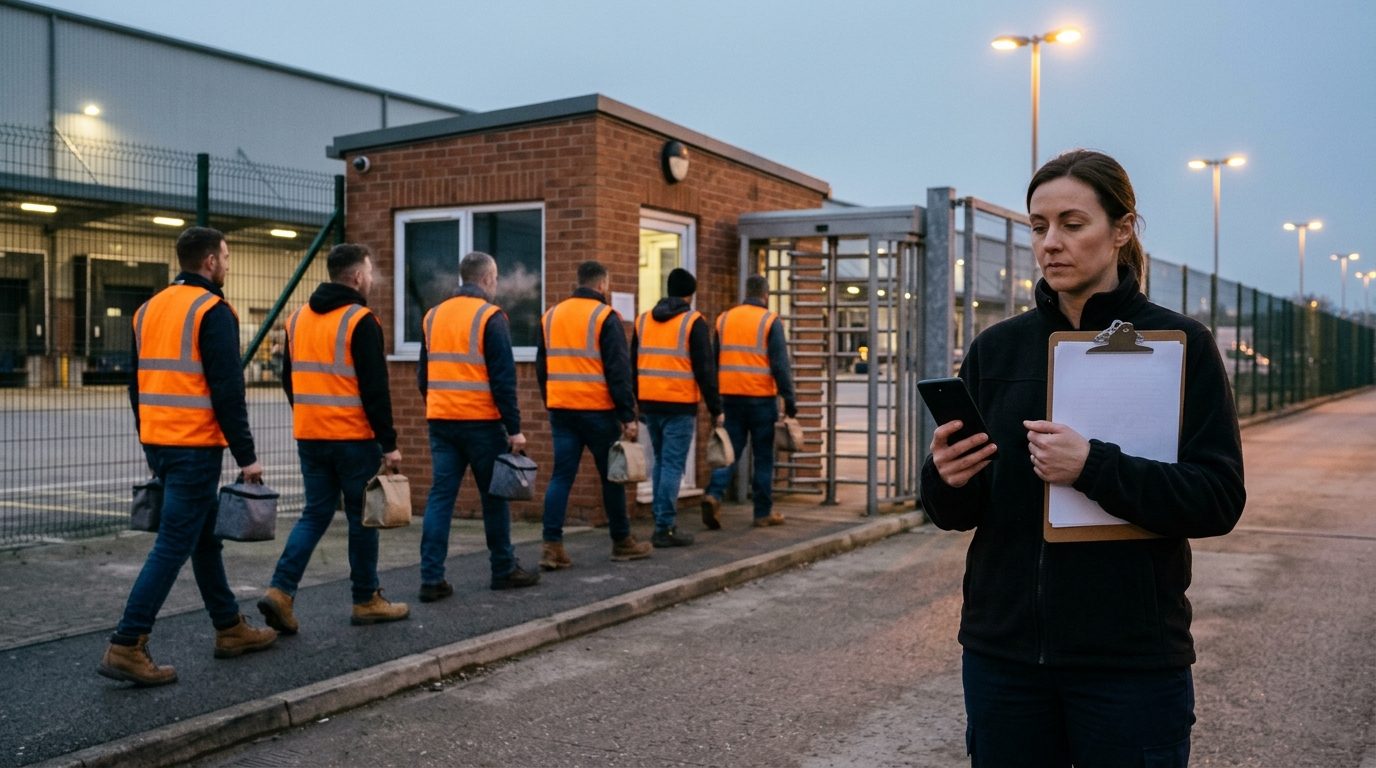
It is 5:40 on a Monday morning and you have fourteen new starts due at a distribution center gate at 6:00. By 6:15 you will know how many of them exist. Every one who does not show is a client problem: the supervisor is short, your account manager gets the call, and the replacement misses the safety briefing.
Most first-day no-shows are decided before the alarm goes off. The worker said yes on Thursday, heard nothing over the weekend, and concluded the job was not real. This is the text sequence that keeps a new start warm from offer to the end of week one: send times, templates, who answers, and what to do with silence.
Why day one is where placements die
The American Staffing Association reports that nearly 2.0 million temporary and contract employees worked for US staffing companies in an average week in 2025, with industrial work the largest slice at 36%. Industrial is also where start times are earliest, instructions are most specific, and the gap between acceptance and first shift is longest.
Workforce software vendor Teambridge argues that light industrial no-shows start in the handoff between recruiter and operations: the placement is marked closed at offer acceptance and the worker hears nothing more until a gate expects them. Staffing agency Verstela, writing on the no-show chain reaction, adds that the starts worth confirming are new starts, early start times and seasonal ramps.
The sequence below is that handoff made visible to the worker. Each text says someone is expecting them.
The five texts from offer to Friday
 Each template comes with its trigger, the wait, and what you do with silence.
Text 1: the acceptance confirmation. Trigger: the worker says yes. Send within the hour from the recruiter's own number, so the number is saved before anything else arrives.
Hi Marcus, this is Dana at Northline Staffing. You're confirmed for the Parkway DC assignment starting Mon 11/10 at 6:00 AM. I'll text you the gate details Sunday. Save this number. Reply STOP to opt out.
Wait: nothing expected back.
Text 2: the day-before details. Trigger: the afternoon before, between 2:00 and 4:00 PM, early enough that silence can still become a phone call. It carries everything they need and asks for one word back.
Marcus, tomorrow (Mon) 6:00 AM at Parkway DC, 4410 Industrial Pkwy. Use Gate B, ask for Luis at the guard shack. Steel toes + the orange vest from orientation. Bring your ID. Reply YES to confirm you're coming.
Wait: three hours. No YES by 7:00 PM, the recruiter calls. Voicemail gets the second-chance text:
Marcus, still planning on you tomorrow at 6. Reply YES or NO so I can plan the crew. If you need a ride or have a problem, tell me now and I'll try to fix it.
Nothing by 8:00 PM and the worker is marked unconfirmed, the client hears that a standby is lined up, and the bench gets a message (see the ladder below).
Text 3: the morning-of nudge. Trigger: unconfirmed starts only, or a client's first-week request. Send it 60 minutes before start: a 4:30 AM text for a 6:00 start reads as harassment, a 5:00 text reads as a colleague checking in.
Morning Marcus, Luis is expecting you at Gate B at 6. Running late? Reply with your ETA and I'll let him know.
Wait: until start plus 15 minutes. An ETA goes straight to the on-site contact. No reply by 6:15 is a no-show and the backfill goes out.
Text 4: the end-of-day-one check-in. Trigger: end of the first shift plus 30 to 60 minutes. This is the text most agencies skip. A new start who hated day one tells nobody; they just do not come back Tuesday.
Marcus, how did day one go at Parkway? Reply 1 (great), 2 (okay), 3 (I have concerns) and I'll call you.
Wait: overnight. A 3 gets a call that evening, a 2 a call the next day, a 1 a thank-you. No reply after a ten-hour shift is not alarming; it gets "Still good for tomorrow at 6?" the next afternoon and the morning-of nudge for day two.
Text 5: the week-one timesheet reminder. Trigger: the day before your cutoff, usually Thursday afternoon. A missed first timesheet means a missed first paycheck, which is how you lose a worker who was otherwise happy.
Marcus, first timesheet is due Fri by 12 PM. Have Luis sign the paper copy or submit in the app before you leave Fri. Stuck? Reply HELP and I'll walk you through it.
Wait: until the cutoff. Anyone outstanding at 10:00 AM Friday gets a second text and a call from the payroll coordinator, who can actually fix it.
Who owns the inbox at 5:45 AM
 The program fails if replies land on a phone that is off until 8:00. Assign each window before the first crew starts.
The day-before window (2:00 to 8:00 PM) belongs to the recruiter who placed the worker. In a branch with four recruiters, each pairs their own Android handset to the shared account, so the worker texts the person they met and every thread still shows in one inbox.
The morning window (5:00 to 7:00 AM) belongs to the early desk, or the on-site coordinator if the account has one. A forwarding rule pushes replies to that person's phone so nobody sits at a laptop at 5:00, and keyword auto-replies handle "late" ("Got it, reply with your ETA and I'll tell the site") and "gate" (the site instructions again) without a human. The evening check-in window is the recruiter's again.
Five quick replies cover a branch: /gate, /late, /ppe, /ts and /ride for the bus route at sites with poor transit.
What a week of new starts looks like
 Here is the inbox for a branch starting a crew of fourteen on Monday.
| Day | Outbound | Inbound to expect | Owner |
|---|---|---|---|
| Sun 2:00 PM | Text 2 to all 14 | Most YES replies by 7:00 PM, a few questions | Placing recruiter |
| Mon 5:00 AM | Text 3 to unconfirmed only | ETAs, "where is Gate B" | Early desk |
| Mon 3:30 PM | Text 4 to everyone who worked | 1s, 2s and a 3 or two | Placing recruiter |
Each row has an owner and a wait, so a quiet phone is a decision rather than a surprise.
The no-reply ladder
Silence means something different at each step, so the response escalates rather than repeats.
- No YES by 7:00 PM the day before. Call. Voicemail gets the second-chance text. This is where most saves happen.
- Nothing by 8:00 PM. Mark unconfirmed, tell the client a standby is arranged, and text the bench: workers oriented for that site, cleared by the client, who told you they want hours.
Northline bench: possible opening at Parkway DC tomorrow 6:00 AM, Gate B, general warehouse, $17/hr. Reply YES if you can be there. First confirmed reply gets it and I'll text you back within 10 minutes either way.
- No-show at start plus 15 minutes. One text to the missing worker asking for an ETA or a NO, then release the standby. The shift fill playbook covers the sixty seconds after that broadcast goes out.
- No reply all day. One text that afternoon asking whether they want to stay on your books.
The bench broadcast is the only place here where one message goes to many people. Keep it to a few dozen pre-screened workers, because hundreds of identical messages in a burst from one line is how a carrier decides a number is a spammer; see sending limits per phone number.
Measuring whether it is working
Three numbers, all already in your applicant tracking system:
- Confirmation rate: new starts who replied YES without a call. If it is low, fix Text 1 or the offer conversation, not Text 2.
- Show rate, confirmed versus unconfirmed: if confirmed starts show far more often, the 7:00 PM calls are worth the recruiter's time.
- Day-two return rate: day-one workers back on day two. This is the number the check-in moves.
Review them Friday by client; a 4:30 AM start behind a confusing gate will always run worse than a 9:00 start through a front door.
Sending it from the phone you already carry
Staffing is not a high-risk category. An agency can usually get an A2P 10DLC campaign approved, and a large firm sending tens of thousands of automated messages a day is better served by a registered aggregator. The branch above is four recruiters and an early desk sending a few hundred messages a week to people who need to recognise the number. For them, brand registration, campaign vetting and monthly fees are overhead on what is really a recruiter texting a worker.
Android Texter runs that traffic through an Android handset the recruiter already owns. Messages go out as person-to-person SMS from the recruiter's real 10-digit number, so the worker sees the number that called with the offer. Every paired phone feeds one shared web inbox, which is what makes the 5:00 AM handoff possible. The rest of the playbook maps to the dashboard:
- Scheduled sends queue Sunday's day-before text on Friday afternoon with an exact send time.
- Quick replies hold the five shortcuts.
- Auto-reply rules answer the "late" and "gate" keywords before the office opens.
- Forwarding rules push early-window replies to the early desk's phone, or to a Telegram channel the on-site coordinators watch.
- The API's broadcast endpoint sends the bench message to up to 500 numbers in one call, pinned to the paired device the bench knows.
There is no 10DLC registration because there is no aggregator in the path.
Consent and opt-out, briefly
None of this changes your obligations under the Telephone Consumer Protection Act. Get the worker's written agreement to assignment texts in the onboarding paperwork, keep it, and put an opt-out line in the first text. Honor STOP, UNSUBSCRIBE, CANCEL, END and QUIT the moment they arrive; our guide to TCPA SMS opt-out rules covers what counts. Android Texter does not keep a suppression list for you: an auto-reply can acknowledge a STOP, but removing the number from your new-start and bench lists is your process to build. Whether an existing relationship with a worker covers texts is a separate question, covered in does an established business relationship cover texts. We do not give legal advice.
Frequently Asked Questions
Should I text or call a new start the day before?
Both, in that order. The text carries the details the worker needs on their phone at 5:30 AM (address, gate, contact, PPE) and asks for a one-word YES. The call is only for people who have not replied by early evening, because an unconfirmed start is the likeliest no-show.
What time should the morning-of text go for a 6:00 AM start?
Sixty minutes before start, so 5:00 AM, and only to workers who did not confirm or are in their first week. Anything earlier wakes someone who was already coming. Ask for one word or a number, such as an ETA, and route the reply to the on-site contact rather than an unstaffed desk.
A worker replied YES and still did not show. What then?
Send one text at start plus 15 minutes asking for an ETA or a NO, release your standby, and move on. That afternoon, one more text asks whether they want to stay on your books. Record the outcome in your ATS and take that worker off the bench broadcast list.
Start Monday's crew this week
Load the five templates into quick replies, schedule Sunday's day-before text, and decide who holds the phone at 5:00 AM. Pair your first recruiter's phone with Android Texter and every new start's reply lands in one inbox the whole branch can see.