
Friday afternoon you sent first-contact texts on 1,200 placed accounts across four handsets. It is Monday at 8:15 and ninety-odd replies are waiting: a dozen "who is this," nine "wrong number," six STOP, four "I don't owe this," two lawyers, and the ones you wanted, "I can do $75 on Friday." Earlier playbooks here cover the first text and the payment plan. This one is about the morning after: who owns each reply, what they type back, and how the reply changes the account record before anyone sends another message.
The eight replies you will actually get
Every inbound after a collections send falls into one of eight buckets.
| Reply | Owner | What it does to the account |
|---|---|---|
| Payment intent ("I can pay Friday") | Collector who owns the account | Promise logged, reminder scheduled |
| Question ("who is this") | Account owner | Right-party check, then the balance conversation |
| Wrong party ("not me") | Inbox lead | Number flagged bad, nothing disclosed |
| Dispute ("I don't owe this") | Compliance queue | Outreach stops pending review |
| STOP, or any plain-language version | Auto-reply plus inbox lead | Opt-out flag set, across channels |
| Attorney or bankruptcy mention | Compliance queue | Represented flag, direct contact stops |
| Hostile | Supervisor | No reply, note, cooling period |
| Silence | Nobody today | Stays in the send cadence |
The owner column is the point. One person triages the four buckets that are about the record; the collector who sent the text handles the two that are about money.
Who owns the inbox: one line per collector
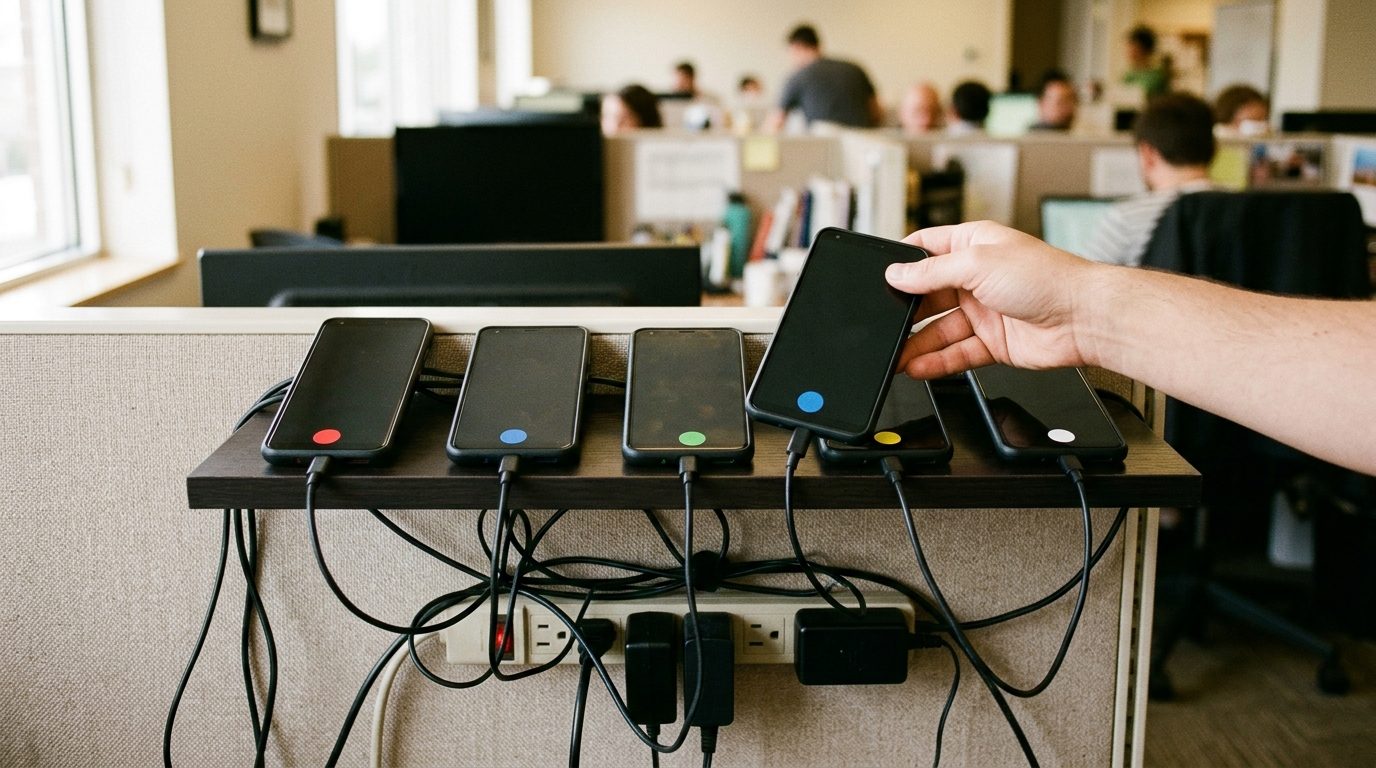 The cleanest routing rule is physical. Each collector pairs their own Android handset to the agency's Android Texter account, so the number a consumer replies to belongs to the collector who sent the text. Every paired phone shares one dashboard inbox, each message carries the device it came through, and the reply is already with the right person when they log in. For a first-contact wave, send from one or two pool handsets owned by the inbox lead, and hand the account to a collector's own line once the right party is confirmed. The consumer sees a new number once, with the collector's name attached.
Two features cover the gap between the dashboard and the floor:
- Forwarding rules route inbound from a specific consumer number, or a pool line, to the owning collector's personal phone or a team Telegram channel, for the collector who is on the dialer all day. Forwarding to Telegram has its own post.
- Webhooks fire a
message.receivedevent for every inbound, with sender number, body and device. Post it into your collection system of record as a note on the account, so the reply exists where the next collector will look. The Zapier app exposes the same event as the New Inbound Message trigger.
The account record is where every flag has to live, because the next contact may not be a text.
What each reply gets back
Every template says it is from a debt collector and says how to stop texts, because Regulation F requires both on every message. The rules section says why.
"Who is this?"
Trigger: any question about the sender before the right party is confirmed. Owner: account owner. Wait: within the hour in business hours; an overnight reply goes out at 8:00 a.m. the consumer's local time.
This is Dana with [Agency Name], a debt collector. I reached out about an account placed with our office. Before I share any details I need to confirm who I'm speaking with. Is this [First Name]? Reply STOP to end texts.
Nothing about the creditor, balance or account goes out until the person confirms.
"Wrong number"
Trigger: "wrong number," "not me," a different name signing off. Owner: inbox lead. Wait: same day, once.
Thanks for letting me know. I've removed this number from the file and you won't hear from us about it again. Sorry for the interruption.
Then, before lunch: mark the number bad, pull it from every list, record the date and the exact reply. Do not ask who they are or explain what the text was about; a wrong-party contact is a third-party disclosure risk.
"I don't owe this"
Trigger: any dispute of the debt, the amount or the debtor's identity. Owner: compliance queue. Wait: one acknowledgement, then nothing from the collector.
This is [Agency Name], a debt collector. I've noted that you dispute this account and passed it to our compliance team. If you want to put the dispute in writing, send it to [mailing address or email]. You'll hear from us by mail about next steps. Reply STOP to end texts.
What happens next depends on where the account is in the validation period, which is compliance's call. Operationally, the account comes off the send list the moment the reply is read.
"I can pay Friday"
Trigger: any offer of a date and an amount. Owner: account owner. Wait: confirm within the hour.
Great, thank you. I have you down for $75 on Friday, November 21. I'll send a short reminder that morning. If you'd rather I call to take the payment, reply with a time that works. [Agency Name], a debt collector. Reply STOP to end texts.
Schedule the reminder as you type the confirmation, through the composer's scheduled-send picker or the API's scheduled_at field, in the consumer's time zone.
STOP
Trigger: STOP, QUIT, END, CANCEL, UNSUBSCRIBE, "stop texting me," or anything a reasonable reader would take the same way. Owner: an auto-reply rule sends the confirmation; the inbox lead does the rest. Wait: the confirmation goes immediately, and it is the only thing that goes.
This confirms your request. You will not receive further text messages from [Agency Name] at this number.
No balance, no payment link, no "call us instead." Regulation F permits a confirmation that says nothing but that the request will be honored, and the FCC presumes one sent within five minutes falls inside the consumer's consent if it carries no marketing.
Now the part the auto-reply cannot do. Android Texter does not keep a suppression list, and nothing in its send path checks whether a number previously said STOP. Flagging the account, pulling the number from every future send, and making the flag visible to the email and dialer teams is the agency's job, the same day.
Attorney, bankruptcy, hostile
An attorney or bankruptcy mention gets one acknowledgement asking the attorney to contact the office, then a represented flag and no further direct outreach. A hostile reply gets no reply: note the account, tell the supervisor, revisit in a week.
A week in the inbox

- Monday. Triage. The inbox lead clears the four record buckets by 10:00 and reconciles every flag against the system of record before the first dialer block. Collectors take their own replies in order of arrival.
- Tuesday to Thursday. Conversations. Collectors work their own threads with quick-reply shortcuts for the lines they type twenty times a day.
- Friday. Promise day. Reminders fire from the schedule queue in the morning. The next first-contact wave goes mid-afternoon, so replies land Monday when the floor is staffed.
- Every day at 4:30. The inbox lead confirms that every STOP, wrong number, dispute and attorney reply has a matching flag in the system of record. This is the ten minutes that prevents the lawsuit.
Regulation F presumes a text before 8:00 a.m. or after 9:00 p.m. at the consumer's location is an inconvenient time, so the scheduler, not the collector's memory, holds the window.
What to measure
Four numbers per send wave: reply rate per handset (a line well below the others may have a delivery problem), right-party confirmation rate (the number this channel is supposed to move), wrong-number rate (above a few percent, blame the placement file), and opt-out rate per collector (rising usually means drifting templates).
The rules that change what you type
 Every text identifies a debt collector. 12 CFR 1006.18(e) requires the initial communication to state that the collector is attempting to collect a debt, and every later one to disclose that it is from a debt collector. A Florida court dismissed a class action on October 31 over texts that allegedly omitted it, but only for lack of concrete harm, and without prejudice.
Every text says how to opt out of texts. 12 CFR 1006.6(e) requires a clear and conspicuous statement of a reasonable and simple method to opt out of further electronic communications to that number.
A STOP by text is, at minimum, a stop on texting. 12 CFR 1006.14(h) bars communicating through a medium the consumer has asked you not to use, with a narrow exception for the confirmation. Courts have gone further. In March 2026 the Middle District of Pennsylvania granted summary judgment in Chamberlain v. NRA Group, holding that a STOP text satisfies the "in writing" requirement of the FDCPA's cease-communication provision, 15 U.S.C. 1692c(c). The collector's own data showed 4,984 numbers that replied STOP and kept receiving texts; the bona fide error defence failed because nobody had checked that the texting vendor honored opt-outs.
The flag has to cross channels. Since September, at least four putative class actions have argued that a STOP text is a written cease request covering email and calls too: Johnson v. Bounce AI (M.D. Fla.), two against TrueAccord (E.D. Pa. and D.N.J.), and Phipps v. South East Client Services (W.D. Tex.), reported by AccountsRecovery on November 13. In the Texas complaint the consumer texted "Stop," got a confirmation, and then allegedly received four collection emails over five weeks. These are allegations, not rulings, but the operational decision need not wait: the STOP flag is set on the account, and whether any further contact on any channel fits a 1692c(c) exception is counsel's question, not the floor's.
Ten business days is a ceiling, not a target. The FCC's revocation rule at 47 CFR 64.1200(a)(10) requires revocations to be honored within a reasonable time not to exceed ten business days, and treats stop, quit, end, revoke, opt out, cancel and unsubscribe as reasonable per se.
Seven-in-seven is about calls. Regulation F's call-frequency presumption at 1006.14(b) counts telephone calls, not texts. Set an internal text cap per account per week anyway.
None of this changes with the channel. Android Texter sends person-to-person SMS from handsets your agency owns, so the carriers' A2P 10DLC vetting, where collections campaigns are frequently rejected or throttled, does not apply. The FDCPA, Regulation F, the TCPA and your state licence apply exactly as before, and sending from a phone does nothing to reduce that exposure. See what counts as STOP, whether a text STOP revokes consent for calls, and for New York City agencies the SHIELD rule post.
Frequently Asked Questions
Should every collector have their own phone number?
For accounts in active negotiation, yes. The consumer replies to the number that texted them, so a collector-owned handset routes the reply with no assignment step, and the consumer deals with one name throughout. Run first-contact waves from a pool line and hand over once the right party is confirmed.
The consumer replied STOP, then texted a question a week later. Can we answer?
Regulation F's prohibited-media rule has an exception for this: if the person initiates contact through a medium they asked you not to use, you may respond once through that same medium. One reply, answering what they asked, with the debt-collector identification. The flag stays set.
Does Android Texter suppress numbers that replied STOP?
No. There is no suppression list in the product and the send path does not check for a prior opt-out. An auto-reply rule can send the confirmation when it sees the keyword. Flagging the account and pulling the number from every list is the agency's responsibility.
A reply came in at 10:40 p.m. Do we answer it then?
Queue it for 8:00 a.m. the consumer's local time. Regulation F presumes texts before 8:00 a.m. or after 9:00 p.m. at the consumer's location are inconvenient, and whether a late consumer-initiated message changes that is not something a collector should decide at night.
Put the replies where the collector already is
If your agency wants each collector on their own line, every reply in one dashboard, and inbound pushed into your system of record by webhook, Android Texter pairs the handsets you already own and gives you the inbox, the forwarding rules and the API. Consent, opt-outs and the account flags remain your responsibility, exactly as they are today.